 Shutter LeagueShutter League
Higher than 93% of images in the League
Recognition level — 8.5 and above is where Shutter League points you to open calls beyond the League
at the moment of a specific action: a takeoff, a landing, a strike, a shake. The motion blur or defocus holds the gesture as pure form, and the action gives the form meaning.
The camera is just the tool. The real instrument is your attention — and your attention is now trained to see what most wildlife photographers walk past.
Boldly executed — you treated a cormorant not as a wildlife subject but as a geometric study, and you committed to the reduction completely instead of hedging with a sharp frame as backup.
What is working
Where it stops short
The same five, every time, on the same scale every evaluation uses.
0.9 separates your strongest dimension from your weakest. That gap is where the next evaluation is won.
Where this reading sits against every photograph the engine has read.
This places you in the top 8% of Creative images evaluated on Shutter League. Your how striking the image is to a stranger score of 8.9 is significantly above the Creative average of 7.2 — you are breaking from convention deliberately and the disruption is landing with viewers, which means the risk you took was calculated and successful.
“Strikingly committed — you reduced two living birds to pure form and held the reduction perfectly.”
Composition · Negative space
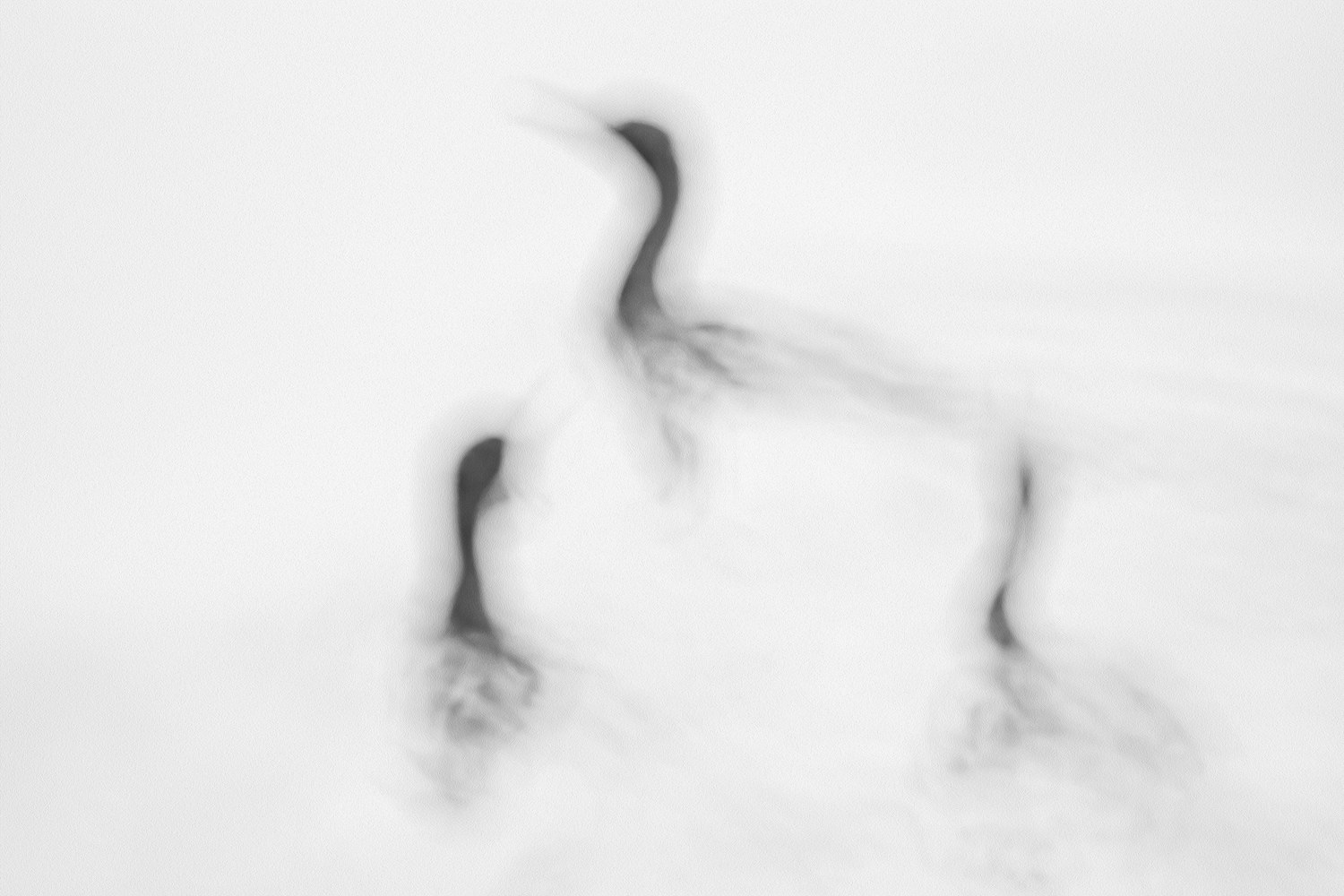
Why this score. Two cormorants in display posture at close range, rendered through intentional motion blur that holds the silhouette forms while dissolving all fine detail — the technical precision required to execute this reduction without losing the subject entirely is exceptionally high, and the compositional decision to commit to pure form against near-white negative space is harder than most photographers attempt.
Why this score. A living bird subject — typically photographed sharp, with feather detail and eye contact — reduced to pure geometric form through extreme defocus or camera movement, breaking every convention of wildlife photography and treating the cormorant as minimalist sculpture rather than biological subject.
Why this score. The upward-stretched neck of the dominant bird is at full extension in what appears to be a greeting or territorial display, and the second bird is positioned in close proximity — this is the peak of the interaction, though the extreme softness means the exact behavioural nuance (bill position, wing angle) is not readable.
Why this score. Eye Wonder at 9.0+ — the photographer found a way to transform one of the most commonly photographed waterbirds into something singular by committing to a reduction that most wildlife photographers would reject, and the image could not exist if the exposure or the motion changed by half a stop or half a second.
Why this score. Suspension — the feeling of being held in a moment that is neither sharp nor blurred but somewhere between, where the subject is present but not fully material, and that specific register of stillness-in-motion creates a resonance that stays with the viewer after looking away.
Standard edit · balanced
Darken the background by one-third of a stop — the near-white field is beautiful but it competes with the white plumage of the birds for luminance dominance, and a slightly darker background would make the birds the clear focal point without losing the high-key minimalist aesthetic.
Increase contrast by 10-15 points globally — the soft tonal transitions are intentional, but a slight contrast lift would separate the birds from the background more decisively and give the forms more presence without adding sharpness.
Crop tighter from the right edge — the second bird is close to the frame edge, and bringing that edge inward by 5-10% would give the composition more breathing room and reduce the sense of the second bird being cut off.
Creative edit · artistic
Convert to pure black-and-white with a high-key luminance map — strip all remaining tonal variation and push the image toward pure graphic form, where the birds become ink-brush gestures on white paper. This would move the image from photographic minimalism into the territory of sumi-e painting, and the emotional register would shift from suspension to absence.
Now open
BR Hills (Biligirirangana Hills) is about 3.5 hours from Bengaluru. Elephant herds move through the reserve in the wet season, and sloth bear sightings increase as fruiting trees come into season. Less visited than Kabini — more genuine access difficulty, more unpredictable animals, and the kind of portfolio-separating frames that come from working in less habituated environments. Based on your location (Bengaluru) · Genre (Creative) · Your growth opportunity (how difficult it was)
Your Decisive Moment has been flat or declining. This is fixable — it is a waiting problem, not a seeing problem. You already know what to look for. The practice is standing still longer.
Across your last 30 photographs, over the past 3 months.
This evaluation is currently based on 3092 calibrated images.