 Shutter LeagueShutter League
Higher than 25% of images in the League
1.6 to go to recognition level (8.5) · best this year 8.18
lia, Iceland, Ethiopia, and the Peruvian Andes displayed on the garden fences. This is a unique opportunity to study how master landscape photographers compose and present images of extreme environments, and to photograph the juxtaposition of exhibited wilderness against formal gardens. The exhibition runs until July 19th — one-off event. Golden hour for photographing both the prints and the garden surroundings. You are already there, right in Paris, no travel needed.
The photograph you almost made is always better than the one you settled for.
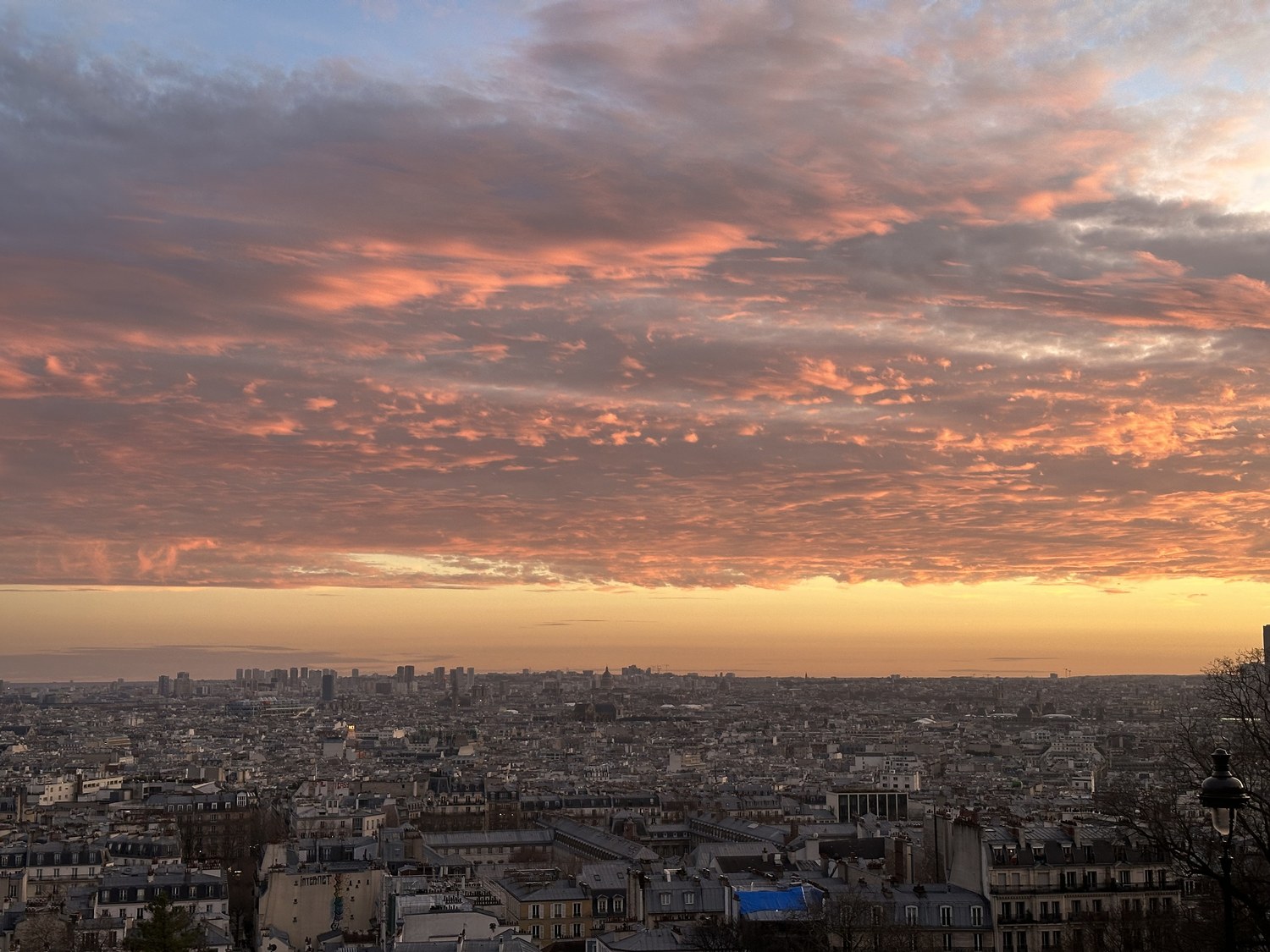
Boldly committed to the sky — you gave the cloud drama two-thirds of the frame and trusted it would carry the image, and it did.
What is working
Where it stops short
The same five, every time, on the same scale every evaluation uses.
2.6 separates your strongest dimension from your weakest. That gap is where the next evaluation is won.
Where this reading sits against every photograph the engine has read.
This places you in the top 32% of Landscape images evaluated on Shutter League. Your how striking the image is to a stranger score of 6.8 is slightly below the Landscape average of 7.2 — the tonal execution and compositional commitment are strong, but the overall visual language follows established sunset cityscape convention; breaking into the top tier requires either a transient element at its geometric peak or a compositional transformation that changes what the familiar scene means.
“You have been working on capturing the right moment, and this frame shows that patience is becoming instinct.”
Composition · Rule of thirds
Why this score. Elevated vantage point access in Paris (Montmartre or similar) at the exact moment of dramatic sunset cloud illumination — situational DoD is moderate (accessible tourist viewpoint, no extreme conditions), technical DoD for mobile is competent (exposure held across bright horizon and darker cityscape without clipping), averaged to mid-range.
Why this score. The two-thirds sky composition with layered cloud drama against dense urban roofscape is a familiar landscape treatment — the mobile capture quality and tonal execution are strong, but the overall visual language follows established sunset cityscape convention.
Why this score. The cloud illumination is at a strong moment — vivid orange and mauve tones across stratocumulus layers — but this is a slow-moving atmospheric event, not a transient peak; the decisive frame would have been the instant a gap in the clouds created a single shaft of light isolating one building or tower, and that window was not captured here.
Why this score. Presence — the feeling of being somewhere at the exact right time — is the primary wonder signal here; the viewer feels the vastness of the city under this specific sky, and that emotional register is genuine and lingering, scoring Eye Wonder at 7.4 for the compositional decision to let the sky dominate.
Why this score. Vastness and solitude — the image creates the specific feeling of standing above a city of millions and feeling entirely alone with the sky; that emotional truth is clear, named, and undeniable, scoring AQ at 7.8.
Standard edit · balanced
Darken the lower third of the frame by one-third of a stop — the cityscape is competing slightly with the sky for luminance attention, and reducing its brightness makes the cloud drama the undeniable focus.
Crop to remove the street lamp and tree branches at the right edge — they are partially visible and create visual noise rather than compositional anchor; a clean right edge lets the eye stay with the sky and horizon.
Increase contrast selectively in the cloud layers — the mauve and orange tones are present but slightly flat; a gentle S-curve on the sky alone (not the cityscape) will separate the cloud layers and make the illumination feel more three-dimensional.
Creative edit · artistic
Convert to black and white and push the sky tones to near-white while holding the cityscape at mid-grey — this transforms the image from a record of beautiful colour into a study of vastness and void, where the city becomes a thin dark line beneath an overwhelming luminous sky; the emotional register shifts from awe to solitude, and the image becomes about scale rather than light.
Now open
Right now, Luxembourg Gardens is hosting an outdoor exhibition titled Fragilities & Resilience featuring landscape photographs by Thibault Gerbaldi — dramatic landscapes from Mongolia, Iceland, Ethiopia, and the Peruvian Andes displayed on the garden fences. This is a unique opportunity to study how master landscape photographers compose and present images of extreme environments, and to photograph the juxtaposition of exhibited wilderness against formal gardens. The exhibition runs until July 19th — one-off event, and you are already there, right in Paris.
Coming up
The Marmottan Monet Museum in Paris hosts Landscape Stories: From Monet to Hockney — a major exhibition tracing 130+ years of landscape representation from Impressionist paintings to contemporary photography, running until January 31st. For landscape photographers, this exhibition provides critical historical context on how the genre has evolved.
Across your last 17 photographs, over the past 88 days.
This evaluation is currently based on 3092 calibrated images.