 Shutter LeagueShutter League
Higher than 16% of images in the League
2.08 to go to recognition level (8.5) · best this year 9.14
Use your phone's wide camera. Get low. Shoot the hands, the gestures, the tools, the light on the floor. The story is in the repetition, not the spectacle.
The camera is just the tool. The real instrument is your attention.
You stayed when others left — the night assembly of the Rath is not the main event, but it is where the human work happens, and that is where the story lives.
What is working
Where it stops short
The same five, every time, on the same scale every evaluation uses.
2.0 separates your strongest dimension from your weakest. That gap is where the next evaluation is won.
Where this reading sits against every photograph the engine has read.
This places you in the top 42% of Documentary images evaluated on Shutter League. Your how striking the image is to a stranger score of 6.8 is slightly above the Documentary average of 6.2 — you are creating visual energy through low angles and motion, but the treatment of the subject is still conventional. The next step is finding the angle or the moment that no one else at the event would think to take.
“You were there at the right time — night, during assembly, when most photographers have already left or have not yet arrived.”
Composition · Diagonal
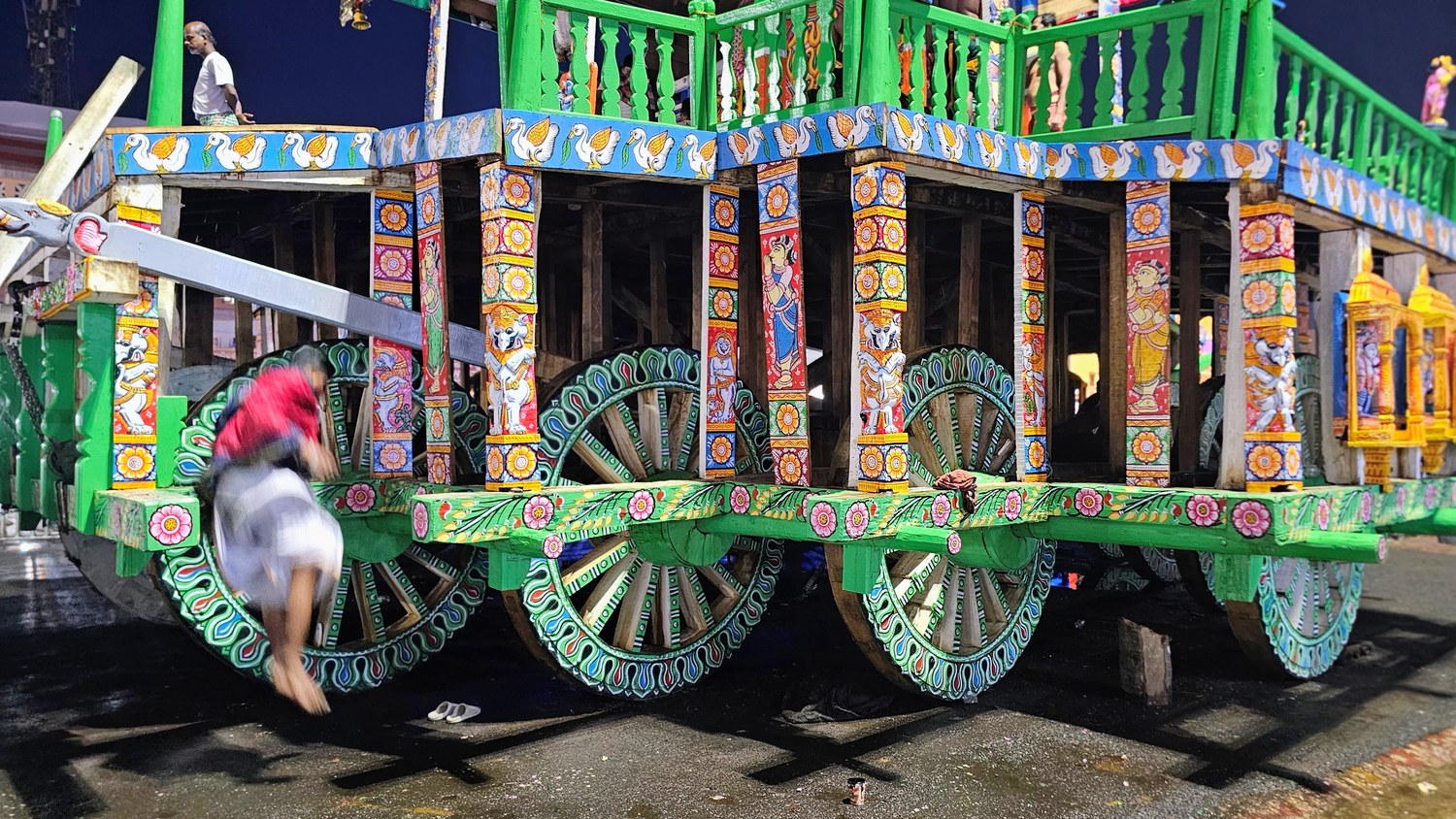
Why this score. Being present at the Rath Yatra in Puri is access that requires planning and timing, but the photographer is local to Bhubaneswar — this is not remote or restricted access. The technical challenge is night shooting at 1/25s handheld on a phone, which the photographer managed without catastrophic blur, but the motion-blurred figure is accidental, not composed, and the frame lacks the precision that would elevate this to skilled night work.
Why this score. The low angle and the motion blur create energy, but the wide-angle treatment of a decorated chariot at a famous festival is the standard frame — thousands of photographers make this exact composition every year at Rath Yatra. The disruption is in the execution (night, motion, phone), not in the visual language.
Why this score. The motion-blurred figure climbing onto the chariot suggests activity and preparation, but the decisive moment for this scene would have been the figure frozen mid-climb with sharp limbs and readable gesture, or the moment of stillness when the chariot was complete and lit but empty — this frame is between those two peaks.
Why this score. Cultural Wonder is present — the Rath Yatra is one of India's most significant religious festivals, and the image documents the preparation ritual that precedes the procession. The wonder is in the tradition itself and the photographer's presence at night during assembly, but the frame does not reveal something about the tradition that a viewer could not learn from standing beside the photographer.
Why this score. The image creates anticipation — the chariot is ready, the figure is in motion, something is about to begin. That feeling is present but not fully resolved. The emotion is closer to 'waiting' than to a specific named feeling like reverence, devotion, or urgency. The night light and the vivid paint create atmosphere, but the blurred figure prevents the viewer from connecting to a human moment.
Standard edit · balanced
Crop tighter from the left to remove the metal pole in the foreground — it competes with the chariot's painted columns and adds visual noise without adding meaning.
Darken the upper background by one stop — the bright green railing and the blue wall are pulling the eye away from the chariot. Reduce their luminance and the chariot becomes the clear focus.
Increase contrast slightly on the painted columns and wheels — the vivid colours are the strength of this image, and a small contrast boost will make them sing against the darker background.
Creative edit · artistic
Convert to black and white and push the contrast hard — the geometric patterns of the wheels, the columns, and the painted deities become graphic shapes, and the motion-blurred figure becomes a ghost in the frame. The image shifts from documentary record to something closer to a dream of the festival, not the festival itself.
Now open
Konark Sun Temple is 65km from you — a 90-minute drive. The annual Konark Dance Festival runs December 1–5, but the temple itself is worth shooting year-round at dawn (5:30–6:30 AM) when the first light hits the carved stone wheels and the tourist crowds have not yet arrived. The frame worth making: a single wheel in side light with the shadow pattern on the stone behind it, or a dancer in traditional dress framed through the temple columns during the festival. The cultural significance is already there — your job is to find the geometry that makes it singular.
You have been shooting within your comfort zone recently. The Depth of Difficulty readings suggest familiar subjects in familiar light. The next level of your work probably requires deliberately harder conditions.
Across your last 30 photographs, over the past 43 days.
This evaluation is currently based on 3092 calibrated images.