 Shutter LeagueShutter League
Higher than 9% of images in the League
2.55 to go to recognition level (8.5) · best this year 6.92
ectly behind it at the exact moment of alignment — the layered relationship is what this frame was reaching toward.
YOUR NEXT BODY OF WORK SEQUENCE: The story is urban wildlife at the margins — the animals that live inside human spaces but remain invisible to most people. Frame 1: a crow, pigeon, or sparrow at ground level in a busy public space — the bird sharp, the human activity blurred behind it. Frame 2: the same species feeding or resting in an unexpected urban location — a ledge, a gutter, a discarded container — showing how they adapt to survive. Frame 3: the moment of interaction or near-miss — a child reaching toward a bird, a vendor shooing one away, a commuter stepping past without noticing — the frame that shows the boundary between human and animal worlds in the same city.
The camera is just the tool. The real instrument is your attention.
A note on your Wildlife eye in a Street frame: Your Wildlife training gave you the patience to get low and wait — most Street photographers would have shot this standing and moved on. The Street gap: you are documenting the scene, not yet capturing the peak geometric relationship between foreground and background that makes the frame unrepeatable.
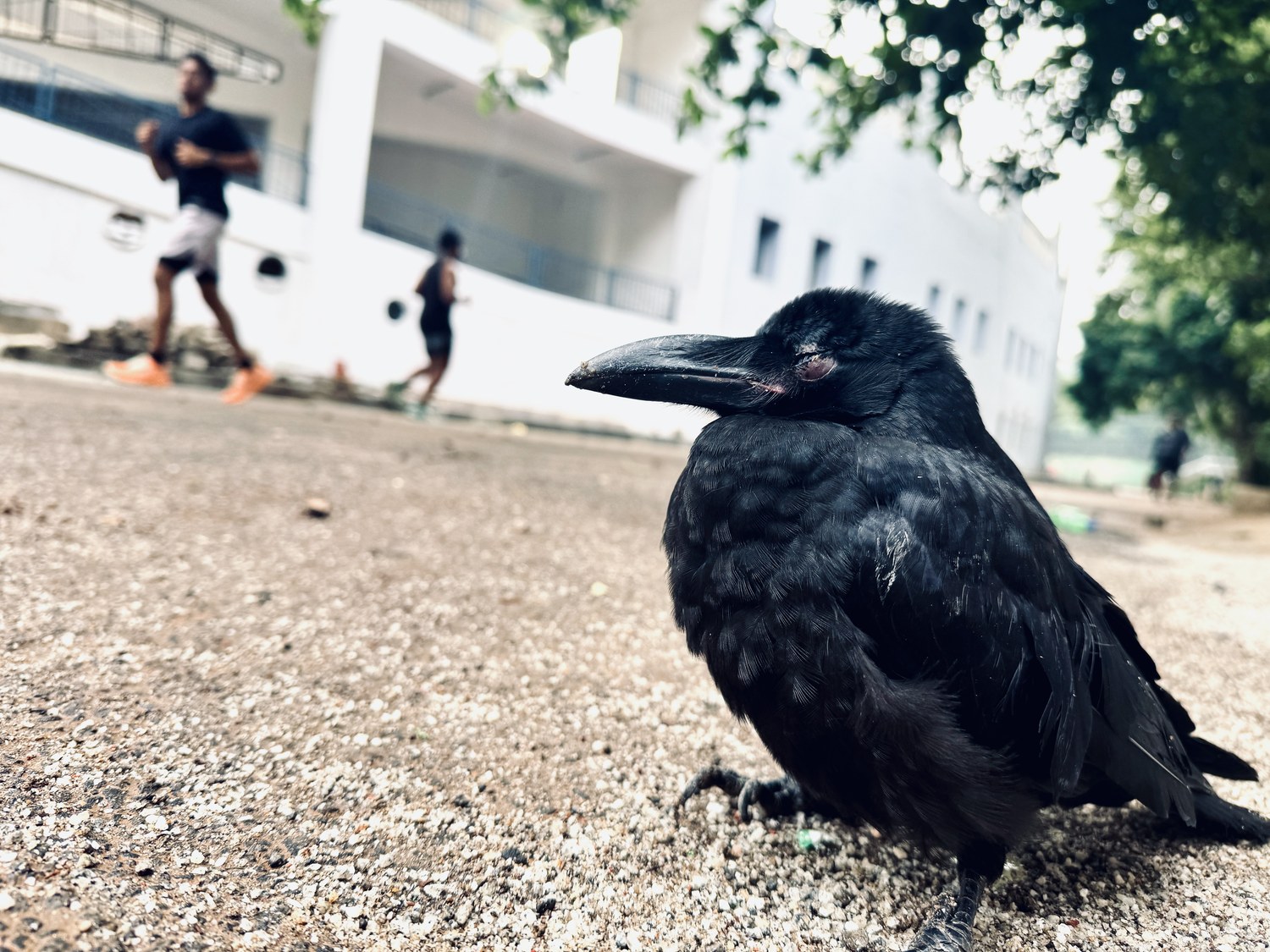
Instinctively, you got low and committed to the proximity — most phone photographers would have shot this standing and moved on, and that low angle is what gives the crow presence and makes the injury visible.
What is working
Where it stops short
The same five, every time, on the same scale every evaluation uses.
1.3 separates your strongest dimension from your weakest. That gap is where the next evaluation is won.
Where this reading sits against every photograph the engine has read.
This places you in the top 42% of Street images evaluated on Shutter League. Your evaluation uses Mobile League weights — Decisive Moment and Visual Disruption are weighted more heavily than in Camera League, recognising that these qualities are harder to achieve on a phone. The effort to get this frame is part of what this evaluation is measuring. Your timing score of 5.5 is below the Street average of 6.8 — the decisive frame was the instant one jogger passed directly behind the crow at exact geometric alignment, and that window existed but was not taken.
“Good instinct — you got low, you saw the vulnerability, and you stopped for it.”
The reading
You got low, you saw the injury, and you stopped for it. The visible damage around the crow's eye, the stillness of the bird against the motion of oblivious joggers, and the low-angle proximity you committed to with a phone — these are the decisions that separate documentation from storytelling. The loneliness here is real.
The technical read
The crow is sharp — the eye, the beak, the visible injury around the eyelid are all cleanly rendered despite the phone sensor and the ground-level angle. The background joggers are motion-blurred but readable, their direction of travel clear, and that separation between sharp foreground and blurred background is exactly what this frame required. The exposure is balanced — the crow is cleanly lit without clipping the white pavement or crushing the black feathers. One observation: the bright patch of pavement in the upper right corner is competing with the crow for attention — a subtle darkening there would strengthen the subject hierarchy.
Composition · Rule of thirds
Eye enters at the crow's visible injury and sharp eye, travels along the body toward the left, then exits into the blurred joggers in the background — the empty pavement space at the right edge adds no narrative and weakens the line.
Imagine if one jogger had passed directly behind the crow at the exact moment you pressed the shutter — the bird in the same position, same injury visible, but the human figure motion-blurred and aligned geometrically so the crow's head sits just below the jogger's torso, creating a layered foreground-background relationship. The scale contrast between the small injured bird and the large oblivious human, the stillness against the motion, and the emotional tension between vulnerability and indifference would all land simultaneously in one frame. That is the image this moment was reaching toward.
Getting to ground level with a phone in an urban park — no viewfinder to hide behind, no telephoto distance — requires nerve and the willingness to be visible to every passerby, and you committed to that proximity.
Why this score. Getting to ground level with a phone in an urban park — no viewfinder to hide behind, no telephoto distance — requires nerve and the willingness to be visible to every passerby, and you committed to that proximity.
The low-angle foreground placement of the crow is a deliberate compositional choice that most phone photographers would not make — the blurred human figures in the background add context without competing, though the overall treatment remains within familiar street-wildlife conventions.
Why this score. The low-angle foreground placement of the crow is a deliberate compositional choice that most phone photographers would not make — the blurred human figures in the background add context without competing, though the overall treatment remains within familiar street-wildlife conventions.
The crow is stationary and the human figures are mid-stride — this is a clean capture of the scene as it existed, but the decisive frame would have been the moment one of the joggers passed directly behind the bird at the exact geometric alignment.
Why this score. The crow is stationary and the human figures are mid-stride — this is a clean capture of the scene as it existed, but the decisive frame would have been the moment one of the joggers passed directly behind the bird at the exact geometric alignment, creating a layered relationship between foreground subject and background motion.
Access wonder — you were close enough to a wild urban crow to render individual feather texture and the visible injury around the eye, a proximity that requires patience and stillness that most viewers would not achieve.
Why this score. Access wonder — you were close enough to a wild urban crow to render individual feather texture and the visible injury around the eye, a proximity that requires patience and stillness that most viewers would not achieve, and the image documents a specific moment of urban wildlife vulnerability.
The feeling is quiet concern — the visible injury, the half-closed eye, the stillness of the bird against the motion of oblivious humans creates a specific melancholy that a stranger would name as loneliness or fragility.
Why this score. The feeling is quiet concern — the visible injury, the half-closed eye, the stillness of the bird against the motion of oblivious humans creates a specific melancholy that a stranger would name as loneliness or fragility.
The Large-billed Crow is one of the most adaptable urban species in South Asia — it thrives in cities, parks, and human-modified landscapes, and the visible injury around this individual's eye is a reminder of the physical cost of living at the margins of human activity.
You saw something most people walk past — the injured crow, the stillness, the vulnerability — and you stopped for it. That instinct is what separates photographers who document from photographers who notice. The next step is waiting for the peak geometric relationship between foreground and background to align, and that patience is what moves a clean capture into the frame that lasts. The standard we are measuring against was built from hundreds of blind calibrations — not preference, not taste — what makes an image hold attention, create feeling, and outlast the five seconds it gets on a feed.
Standard edit · balanced
Darken the upper right corner — the bright patch of pavement is competing with the crow for the eye. Remove that competition and the subject becomes the clear focus.
Increase contrast slightly on the crow itself — the black feathers and the visible injury around the eye are the emotional anchor, and a subtle lift in local contrast makes that detail more immediate.
Crop tighter from the right edge — the empty pavement space at the right adds no narrative and weakens the compositional tension between the bird and the background figures.
Creative edit · artistic
Convert to black and white and crush the shadows — the injury, the stillness, and the isolation become stark and undeniable, and the frame shifts from documentation to elegy.
Now open
Cubbon Park is close by. Early morning — 06:30 to 07:30 — the light is soft, the walkers and joggers are out, and the crows, mynas, and parakeets are active and visible at ground level. The frame worth making: a bird feeding or resting in the foreground, a human figure passing behind it at the exact moment of alignment — the layered relationship between stillness and motion.
This evaluation is currently based on 3092 calibrated images.