 Shutter LeagueShutter League
Higher than 13% of images in the League
2.18 to go to recognition level (8.5) · best this year 7.82
framed against the street activity behind them.
YOUR NEXT BODY OF WORK SEQUENCE: The story is Bengaluru in motion — the city that never stops moving. Frame 1: a BMTC bus at dawn, empty, waiting at a terminus — the stillness before the day begins. Frame 2: a conductor leaning out of a moving bus, arm extended, calling passengers — the human moment inside the machine. Frame 3: a child's face pressed against a bus window at dusk, watching the city pass — the frame that stays with you after you close the book.
The camera is just the tool. The real instrument is your attention.
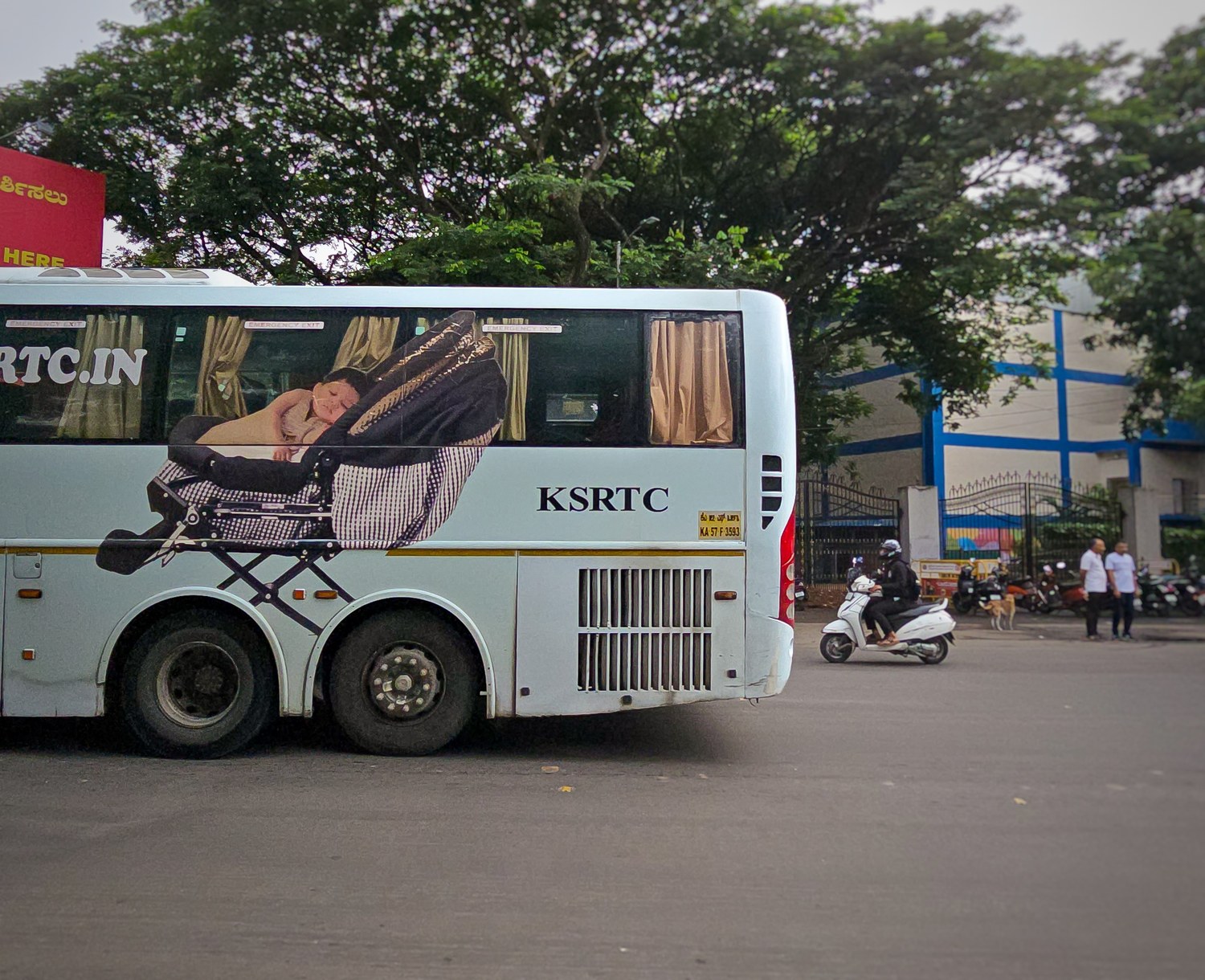
Instinctively, you recognised the irony — the sleeping baby labelled 'silence' against the noise and motion of a Bengaluru street — and you stopped to frame it.
What is working
Where it stops short
The same five, every time, on the same scale every evaluation uses.
1.0 separates your strongest dimension from your weakest. That gap is where the next evaluation is won.
Where this reading sits against every photograph the engine has read.
This places you in the top 43% of Street images evaluated on Shutter League. Your evaluation uses Mobile League weights — Decisive Moment and Visual Disruption are weighted more heavily than in Camera League, recognising that these qualities are harder to achieve on a phone. The effort to get this frame is part of what this evaluation is measuring. Your how striking the image is to a stranger score of 6.8 is slightly above the Street average of 6.2 — you are finding frames that create mild visual surprise, and the next step is simplifying the composition so the surprise reads immediately rather than competing with background noise.
“Lovely eye — you stopped for a visual pun that most people would have walked straight past.”
The reading
You saw the irony here — the sleeping baby graphic labelled 'silence' on a KSRTC bus against the noise and motion of a Bengaluru street — and you stopped to frame it. That recognition is the street photographer's instinct. The challenge is that the frame contains six competing elements (bus, scooter, dog, pedestrians, motorcycles, building) and no clear hierarchy, so the irony you saw takes effort to find rather than arriving immediately.
The technical read
The primary subject — the bus panel with the baby graphic — is sharp and cleanly exposed. The overcast light has kept the white bus panel from clipping and the colours true. Your phone's 13mm ultrawide lens has held the full context (trees, scooter, pedestrians, building) in frame, which is both the strength and the limitation — the wide field of view captures the scene but does not isolate the irony you saw. The EXIF confirms Samsung Galaxy S24 Ultra rear ultrawide camera — this is the lens that performs best when you move physically closer to simplify the frame rather than relying on the wide angle to hold everything.
Eye enters at the white bus panel and the baby graphic, moves right toward the scooter rider, then scatters across the dog, pedestrians, and parked motorcycles without settling — the empty road space in the lower third and the tree canopy in the upper third add no narrative and dilute the visual pun.
Imagine if you had moved three steps closer to the bus so the baby graphic filled the left half of the frame, and the scooter rider was positioned in the right third — helmet visible, body leaning into motion — so the frame became a clean two-element composition: stillness advertised, motion actual. The dog, pedestrians, and parked motorcycles are gone. The trees are cropped out. The road is simplified to a clean grey band at the bottom. The irony reads in two seconds instead of requiring a search. That is the frame this moment was reaching toward.
The social invisibility of a phone in a public street allowed you to frame this without altering the scene, but the technical execution is straightforward daylight work with no environmental or access challenge beyond recognition speed.
Why this score. Capturing a visual pun on a moving bus in mixed traffic requires quick recognition and timing — the social invisibility of a phone in a public street is the access advantage here, but the technical execution is straightforward daylight work with no environmental challenge.
The visual pun is a classic street irony find — the treatment is conventional documentary framing, but the pairing of the sleeping baby graphic with the waking street creates mild surprise.
Why this score. The juxtaposition of the sleeping baby advertisement against the active street scene is a classic street irony find — the treatment itself is conventional (straight documentary framing) but the pairing creates mild visual surprise.
The bus is stationary or moving slowly, the scooter is in transit, the dog is ambient — no behavioural peak is present, just the alignment of the visual pun elements across a multi-second window.
Why this score. The bus is stationary or moving slowly, the scooter rider is in transit, the dog is ambient — no peak behavioural instant is present, just the alignment of the visual pun elements which could have been captured across a several-second window.
Eye Wonder is present — you noticed the sleeping baby graphic and framed it against the street activity to create ironic contrast — but the find is gentle rather than arresting, and the clutter dilutes the impact.
Why this score. Eye Wonder is present — the photographer noticed the sleeping baby graphic and framed it against the waking street, creating a mild ironic contrast that most people would walk past, but the find is gentle rather than arresting.
A stranger would feel mild amusement at the irony — the sleeping baby labelled 'silence' against Bengaluru traffic — but the emotion is closer to a smile than a feeling that stays, and the busy frame makes the pun work rather than land immediately.
Why this score. A stranger would feel mild amusement or recognition of the irony — the sleeping baby labelled 'silence' against the noise and motion of Bengaluru traffic — but the emotion passes quickly and is closer to a smile than a feeling that stays.
You are noticing what others walk past — the visual pun between the sleeping baby and the waking street is a street photographer's instinct, and you acted on it. The next step is simplifying the frame so the irony you saw reads immediately rather than competing with background noise. An image at this level is building the habit of seeing — the real work in street photography is not the shutter, it is the recognition that something worth framing is happening. You have that. The standard we are measuring against was built from hundreds of blind calibrations — not preference, not taste — what makes an image hold attention, create feeling, and outlast the five seconds it gets on a feed.
Standard edit · balanced
Crop tighter from the left edge — remove the red sign and some of the tree canopy so the bus panel becomes the dominant element and the baby graphic reads immediately.
Darken the background pedestrians and parked motorcycles slightly — they are competing with the bus for visual weight, and reducing their brightness pushes them into supporting context rather than equal subjects.
Increase contrast by one step — the overcast light has flattened the image slightly, and a modest contrast lift will separate the white bus panel from the grey road and green trees more clearly.
Creative edit · artistic
Convert to black and white and crush the shadows hard — the baby graphic becomes a high-contrast graphic element against a dark street, and the irony shifts from gentle to stark.
Now open
Church Street near the old Koshy's corner is close by — early morning before the shops open, the street cleaners and delivery workers create human moments against the colonial-era storefronts and signage. The light is soft, the street is quiet, and the frames worth making are the ones where a single person interacts with the architecture or text in a way that creates meaning.
This evaluation is currently based on 3092 calibrated images.