 Shutter LeagueShutter League
Higher than 8% of images in the League
2.56 to go to recognition level (8.5) · best this year 9.12
es. Arrive before 8am when the light is still soft and people are present but not crowded. Position yourself so a person interacting with the monument (reading, resting, walking past) is in the frame. That interaction is the story. Your phone's wide lens will capture both.
The photograph you almost made is always better than the one you settled for. The gap between almost and made is usually one decision — and it is usually made before the shutter opens.
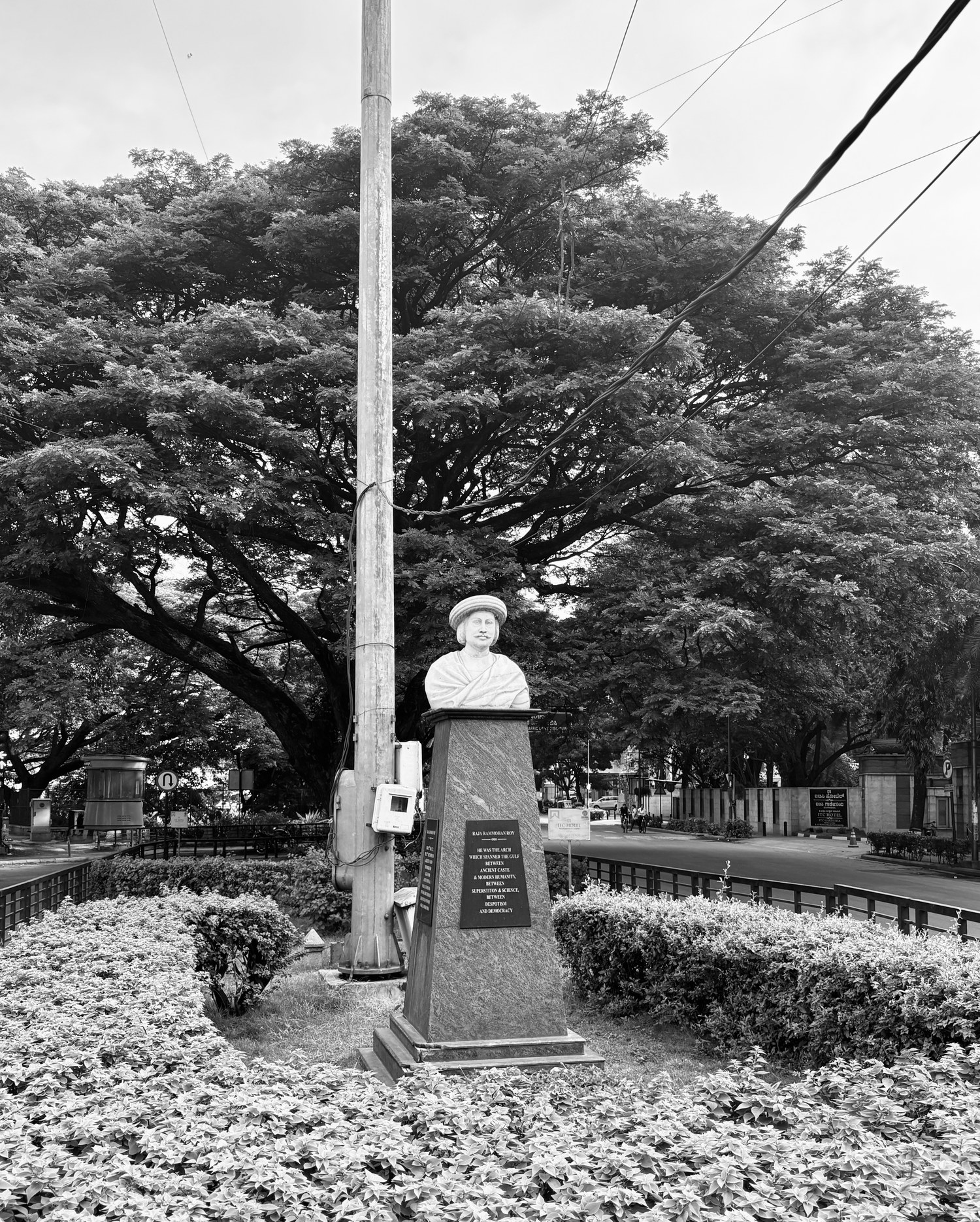
You included the infrastructure — the pole, the wires, the urban grid — rather than reframing to exclude it. Most photographers treat utility poles as obstacles to crop out. You treated them as part of the scene. That is a documentary instinct.
What is working
Where it stops short
The same five, every time, on the same scale every evaluation uses.
1.6 separates your strongest dimension from your weakest. That gap is where the next evaluation is won.
Where this reading sits against every photograph the engine has read.
This places you in the top 42% of Street images evaluated on Shutter League. Your how striking the image is to a stranger score of 6.8 is above the Street average of 6.2 — you are making compositional choices that depart from convention, which is the right instinct. The next step is to make those choices deliberate rather than accepted, and to add the human element that turns structure into story.
“You stopped for a monument most people walk past without looking up.”
Composition · Symmetry
Why this score. Photographing a public monument in open daylight with a phone requires no physical access difficulty, no environmental challenge, and no technical execution beyond standard exposure — the difficulty is in the compositional decision to include the pole and wires, not in the capture itself.
Why this score. The decision to include the utility pole and overhead wires as compositional elements rather than obstacles is a departure from conventional monument photography — most photographers would reframe to exclude infrastructure, but the disruption is incomplete because the pole bisects the frame without creating a clear geometric relationship with the monument.
Why this score. The moment is static — no human interaction, no light change, no temporal peak — the decisive choice was compositional (where to stand, what to include) rather than temporal, and the pole placement suggests the photographer accepted the infrastructure rather than using it as a deliberate framing device.
Why this score. The image documents a specific historical monument (Raja Ram Mohan Roy) in its urban context, which carries cultural significance, but the wonder is limited because the monument itself is the subject rather than a discovered juxtaposition or emotional moment — the viewer learns what is there, not something unseen about what is there.
Why this score. The image creates a feeling of civic presence — the monument exists in its everyday urban environment, surrounded by infrastructure and foliage, which gives it a grounded, lived-in quality rather than a heroic or isolated one — but the emotion is observational rather than specific, closer to documentation than to a named feeling like reverence, neglect, or resilience.
Standard edit · balanced
Darken the upper third of the frame (tree canopy and sky) by one stop — the bright foliage is competing with the monument for visual weight, and reducing that brightness lets the white marble bust become the clear focal point.
Crop tighter from the left and right edges to remove the peripheral hedges and road — the monument and tree are the subjects, and the road median context is already established. A tighter crop gives the monument more presence in the frame.
Increase contrast slightly in the marble bust to separate it further from the midtone background — the bust is reading as flat because the tonal range is compressed. A small contrast boost in the highlights will give it dimensionality.
Creative edit · artistic
Convert to a high-contrast graphic treatment — pure black shadows, pure white highlights, no midtones — and the monument becomes a silhouette against the tree canopy, the inscription disappears, and the image shifts from documentary record to urban abstraction. The pole and wires become part of the graphic structure rather than a distraction. The feeling changes from civic presence to urban geometry.
Now open
KR Market is zero distance from you — you are already in Bengaluru, no travel needed. The pre-monsoon season brings peak flower supply to the market, and before 7am the overcast light is diffused with no harsh shadows — this is the window where street light is at its most forgiving. One frame before breakfast. Based on your location (Bengaluru) · Genre (Street) · Your growth opportunity (adding human narrative to geometric structure)
Depth of Difficulty has been your quietest dimension lately. That often means you are in a productive groove — but grooves become ruts. One session deliberately outside your usual parameters would change this.
Across your last 10 photographs, over the past 64 days.
This evaluation is currently based on 3092 calibrated images.