 Shutter LeagueShutter League
Higher than 6% of images in the League
2.6 to go to recognition level (8.5) · best this year 9.21
Position yourself so the sun will set in the left or right third of your frame, not the centre. Wait for a boat, a bird, or a person to cross the light path. That is your decisive moment. Take the frame when the moving element intersects the sun's reflection on the water.
YOUR NEXT BODY OF WORK SEQUENCE: The story is 'The Edge of the Day' — four frames that together show what happens when light leaves. Frame 1: Wide — the last light on water, a boat returning to shore, silhouetted against the red sky. Frame 2: The shoreline — a fisherman pulling nets in the final minutes of workable light, his shadow long on wet sand. Frame 3: Close — hands coiling rope, the gesture of finishing, the light nearly gone. Frame 4: The frame that stays with you — the empty boat tied to a post, the water now dark, one last streak of orange on the horizon. Each frame advances the story. Together they are the feeling of a day ending.
The camera is just the tool. The real instrument is your attention.
A note on your Wildlife eye in a Landscape frame:
Your Wildlife training taught you to wait for the right light and to underexpose for the subject that matters — that discipline is visible here in the silhouette decision and the protected sky gradient. Most Landscape photographers learning on their own would have tried to lift the foreground and lost the colour. You did not. That is Wildlife patience applied to a different genre, and it worked. What Wildlife did not prepare you for: the need for a transient element to complete the geometry. In Wildlife, the subject moves and you react. In Landscape, the place is static and you must wait for something to move through it — a boat, a bird, a cloud, a wave — to create the decisive moment. The drill that closes this gap: next time you are at a landscape location with good light, do not take the frame when you arrive. Wait 10 minutes. Watch what moves through the scene. The frame you take after waiting will score higher than the frame you took when you arrived. That is the Landscape discipline your Wildlife eye has not yet learned.
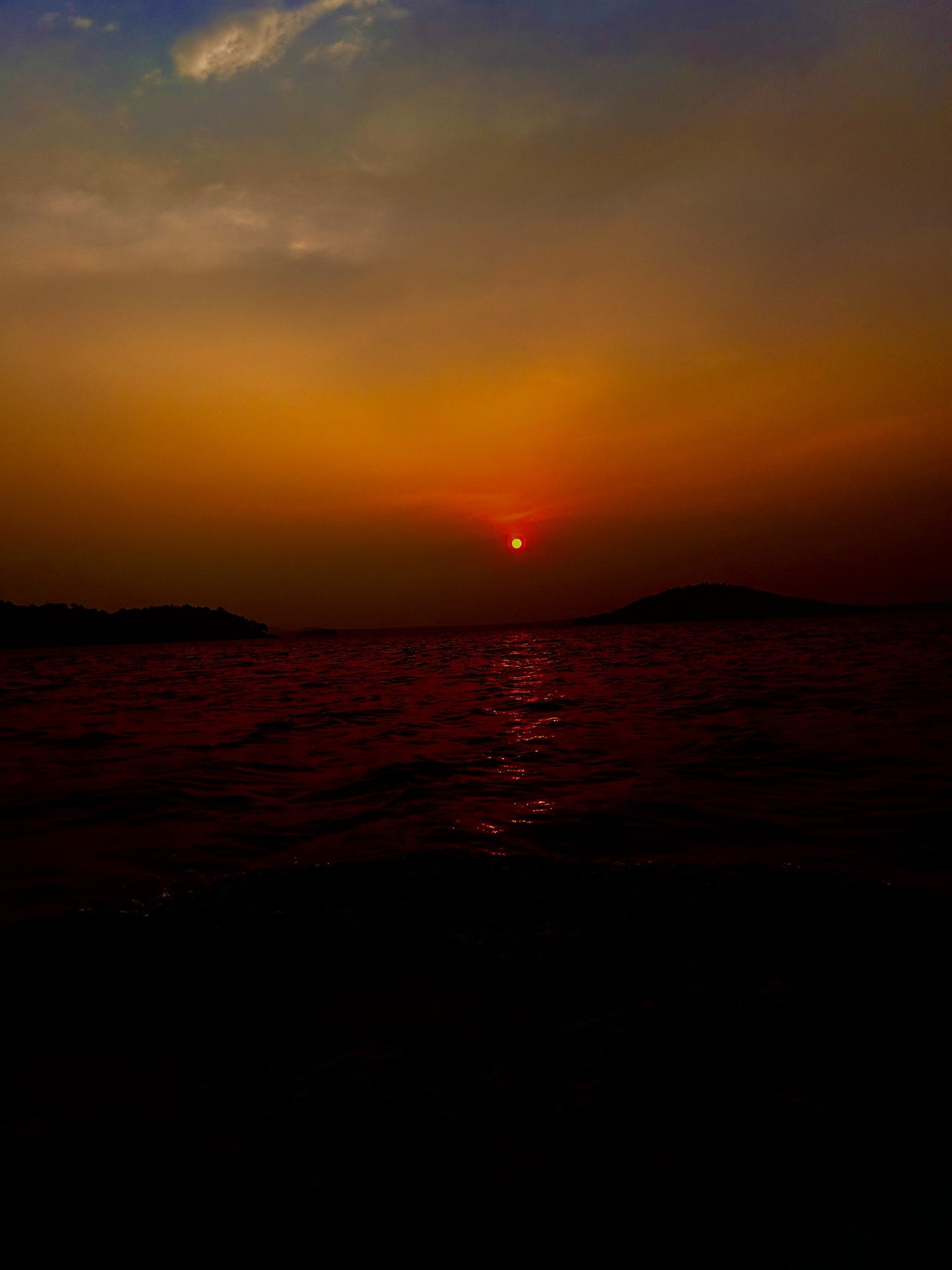
You made the silhouette decision — underexposing the foreground completely to protect the sky gradient — and that is what most photographers at this scene would not have done. They would have tried to lift the water and lost the colour. You did not.
What is working
Where it stops short
The same five, every time, on the same scale every evaluation uses.
3.0 separates your strongest dimension from your weakest. That gap is where the next evaluation is won.
Where this reading sits against every photograph the engine has read.
This places you in the top 42% of Landscape images evaluated on Shutter League. Your how well you captured the right moment score of 4.5 is below the Landscape average of 6.2 — a landscape decisive moment requires a transient element to resolve against a permanent one, and this frame is the colour gradient waiting for something to move through it.
“You stopped for the light — and the gradient from red through orange to blue is what makes this frame worth keeping.”
Composition · Symmetry
Why this score. Accessible coastal location at sunset — the timing window is predictable and the position requires no physical difficulty or environmental hostility beyond arriving before dusk.
Why this score. The silhouetted landmass framing and the deep red-to-blue gradient push slightly beyond the standard sunset postcard, but the centred sun and symmetrical composition follow familiar conventions.
Why this score. The sun is at the horizon line — the classic sunset moment — but no transient element (boat crossing the light path, bird in the frame, wave at geometric peak) resolves simultaneously to create a landscape decisive moment.
Why this score. The colour gradient from deep red through orange to blue creates a specific atmospheric presence — the feeling of being at the edge of the day — and that emotional register is what lifts this above documentation.
Why this score. Stillness — the image creates the feeling of suspension, the moment between day and night when everything pauses, and that specific emotion is clear and genuine.
Standard edit · balanced
Darken the water in the lower third by one stop — the faint texture is competing with the sky gradient. Remove that competition and the colour becomes the undeniable focus.
Crop to 16:9 or 2:1 aspect ratio, placing the horizon lower in the frame — this gives the gradient more vertical space to breathe and reduces the visual weight of the dark water.
Slightly increase contrast in the sky only — this will separate the colour bands more distinctly and make the red-to-orange-to-blue transition more defined without affecting the silhouetted landmass.
Creative edit · artistic
Convert to black and white and push the contrast to maximum — the silhouette becomes pure graphic form, the gradient becomes tonal separation, and the image transforms from a sunset record into a study of light and absence. The stillness becomes loneliness.
Now open
Hesaraghatta Lake is about 40 minutes from you. The water level is low this season and the exposed mudflats create long reflections at sunset. Arrive 30 minutes before sunset, position yourself on the western shore, and wait for the cormorants to fly back to roost — they cross the light path in formation just as the sun touches the horizon. That is your transient element. The frame is the birds in silhouette against the red sky, their reflections doubling on the still water.
You have been shooting within your comfort zone recently. The Depth of Difficulty readings suggest familiar subjects in familiar light. The next level of your work probably requires deliberately harder conditions.
Across your last 30 photographs, over the past 67 days.
This evaluation is currently based on 3092 calibrated images.