 Shutter LeagueShutter League
Higher than 99% of images in the League
Grandmaster-level work — 9.0 and above is the highest level Shutter League sees
re births are seasonally predictable — arrive before dawn and stay through midday, because births happen on the animal's schedule, not yours, and the light you want is the soft overcast window that does not create harsh shadows on newborns.
YOUR NEXT BODY OF WORK SEQUENCE: The story is Life At Its Most Vulnerable — four frames that together show what it means to be born in the wild. Frame 1: The birth itself — this image, or one like it, where the newborn is mid-emergence and the mother is in contact. Frame 2: The first stand — wobbly legs, the mother watching, the calf's first attempt to balance, shot low to the ground so the viewer feels the instability. Frame 3: The herd's response — other giraffes or elephants approaching to investigate, the social structure acknowledging the new life, shot wide to show the community context. Frame 4: The first steps away from the birth site — mother and calf walking together into the savanna, shot from behind so the viewer sees them moving into the world, not toward the camera. Together, these four frames tell the story of what it costs to survive the first hour.
A note on your Wildlife eye in a Creative frame: You filed this as Creative, but this is Wildlife photography at its absolute peak — the discipline, the access, the patience, and the mechanical precision are all Wildlife skills, and they are why this image scores Grandmaster. Creative technique — ICM, long exposure, intentional blur — is a different language entirely, and your strength is in the decisive moment and the access, not in abstract rendering. If you want to explore Creative as a genre, start with panning or long-exposure water — techniques that reward the same timing instinct you already have. But do not abandon what you do at this level. This is the frame that defines a career.
Brilliantly patient — you stayed through an unpredictable event and captured the exact instant when the mother made first contact with her newborn, a decision that required you to ignore every other potential frame and commit to the one moment that mattered.
What is working
Where it stops short
The same five, every time, on the same scale every evaluation uses.
1.8 separates your strongest dimension from your weakest. That gap is where the next evaluation is won.
Where this reading sits against every photograph the engine has read.
This places you in the top 2% of Wildlife images evaluated on Shutter League. Your how striking the image is to a stranger score of 7.8 is slightly below the Wildlife average of 8.1 — the subject rarity is exceptional, but the framing is conventional, and that gap is what separates a Grandmaster frame from a Legend-tier frame that redefines how the subject is seen.
“Exceptionally rare access — you were present for a moment that defines wildlife photography at its highest level: not the portrait, not the behaviour, but the instant of life itsel”
Composition · Rule of thirds
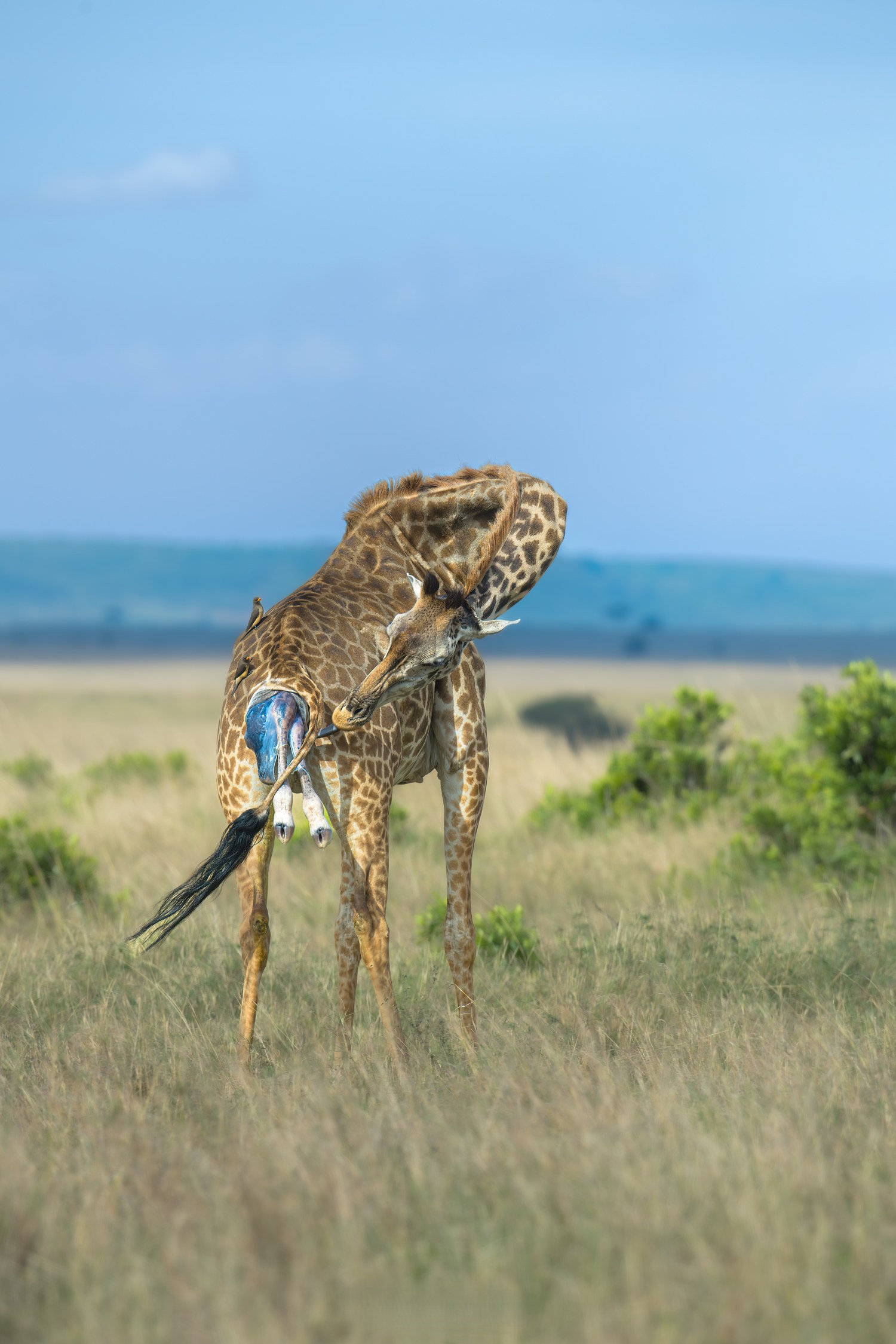
Why this score. Capturing a Masai Giraffe giving birth in the wild — the calf mid-emergence with the blue amniotic sac visible, the mother bending to nuzzle it, both subjects sharp at 500mm in open savanna — requires access to a calving event that most wildlife photographers will never witness, combined with the mechanical precision to hold focus on two subjects in physical contact at a decisive instant.
Why this score. The birth moment itself is rare in published wildlife photography — most giraffe images are portraits or feeding behaviour — but the framing is conventional: centred subject, standard savanna background, no compositional surprise beyond the subject rarity itself.
Why this score. The mother's neck is bent to its maximum arc, the calf is mid-emergence with hooves dangling and the amniotic sac at peak visibility, and both subjects are in contact at the exact instant of the first maternal touch — this is the geometric and behavioural peak of the birth sequence, and the frame captured it.
Why this score. Access Wonder at its highest level — the photographer was present for a wild giraffe birth, a moment that requires days of tracking, ecological knowledge, and the patience to wait through labour without disturbing the animal, combined with Emotional Wonder: the tenderness of the first maternal contact is undeniable, and the viewer feels the vulnerability and care simultaneously.
Why this score. Tenderness — the mother bending to meet her newborn, the fragility of the calf mid-emergence, the blue membrane as a visual signal of life at its most vulnerable instant — creates a specific, named emotion that is impossible to look away from, and the feeling lingers after the image closes.
Standard edit · balanced
Darken the upper third of the frame by one-third of a stop — the pale blue sky is visually neutral and draws the eye upward away from the subjects. Reducing its brightness keeps the viewer's attention on the mother and calf.
Increase contrast on the blue amniotic sac by 10-15% — it is the visual anchor of the birth moment, and making it slightly more saturated and distinct ensures it reads clearly as the signal of life at its most vulnerable.
Crop tighter from the right edge to remove the empty savanna space — the frame gains intensity when the subjects fill more of the canvas, and the current composition has unused space that does not contribute to the story.
Creative edit · artistic
Convert to black and white with a yellow filter simulation to emphasise the tonal separation between the mother's dark coat and the pale calf — the tenderness becomes sculptural, and the blue sac becomes a luminous grey that holds the eye. The frame transforms from documentary to timeless.
Now open
BR Hills (Biligirirangana Hills) is about 3.5 hours from you. Elephant herds are moving through the reserve in the wet season right now, and sloth bear sightings are increasing as fruiting trees come into season. This is the less obvious choice that separates portfolios — less visited than Kabini means less habituated animals, more genuine difficulty, and the kind of access that scores exceptionally on the difficulty dimension. Book through Jungle Lodges and plan for full-day shoots in overcast light.
You have been shooting within your comfort zone recently. The Depth of Difficulty readings suggest familiar subjects in familiar light. The next level of your work probably requires deliberately harder conditions.
Across your last 30 photographs, over the past 67 days.
This evaluation is currently based on 3092 calibrated images.