 Shutter LeagueShutter League
Higher than 98% of images in the League
Grandmaster-level work — 9.0 and above is the highest level Shutter League sees
and wait for a subject (bird, squirrel, person) to move through that light. Shoot at f/4.0 or wider, expose for the lit subject, and let the surrounding frame fall into shadow. Your D850 at ISO 160-400 will hold both extremes cleanly.
YOUR NEXT BODY OF WORK SEQUENCE: The story is 'Light as Subject — Four Frames Where the Light Defines the Moment'. Frame 1: A single shaft of light in a dark interior space (temple, warehouse, alley) with no subject — pure geometry. Frame 2: A person or animal entering that light shaft from shadow — the moment of transition. Frame 3: The subject fully illuminated, surrounded by darkness — the frame you made today. Frame 4: The light fading or the subject leaving — the moment after the peak, where absence becomes the subject. Together, these four frames tell the story of light as a living, transient thing.
The photograph you almost made is always better than the one you settled for — but this time, you did not settle, and the frame you made is the one that matters.
A note on your Wildlife eye in a Creative frame:
Your Wildlife discipline gave you something most Creative photographers lack — the patience to wait for the exact geometric moment and the technical precision to execute it without clipping the extremes. That is why this frame scored Grandmaster. The gap between 9.15 and 9.5+ is not technical — it is compositional risk. Wildlife trains you to centre the subject because that is where the behaviour happens. Creative rewards you for placing the subject at the edge, where tension lives. The drill: shoot the same minimalist frame twice — once with the subject centred (your instinct), once with the subject at the frame edge (the risk). Compare them. The edge frame will feel wrong at first. That discomfort is the signal that you are learning a new visual language. Your Wildlife eye is ready for this. Take it there.
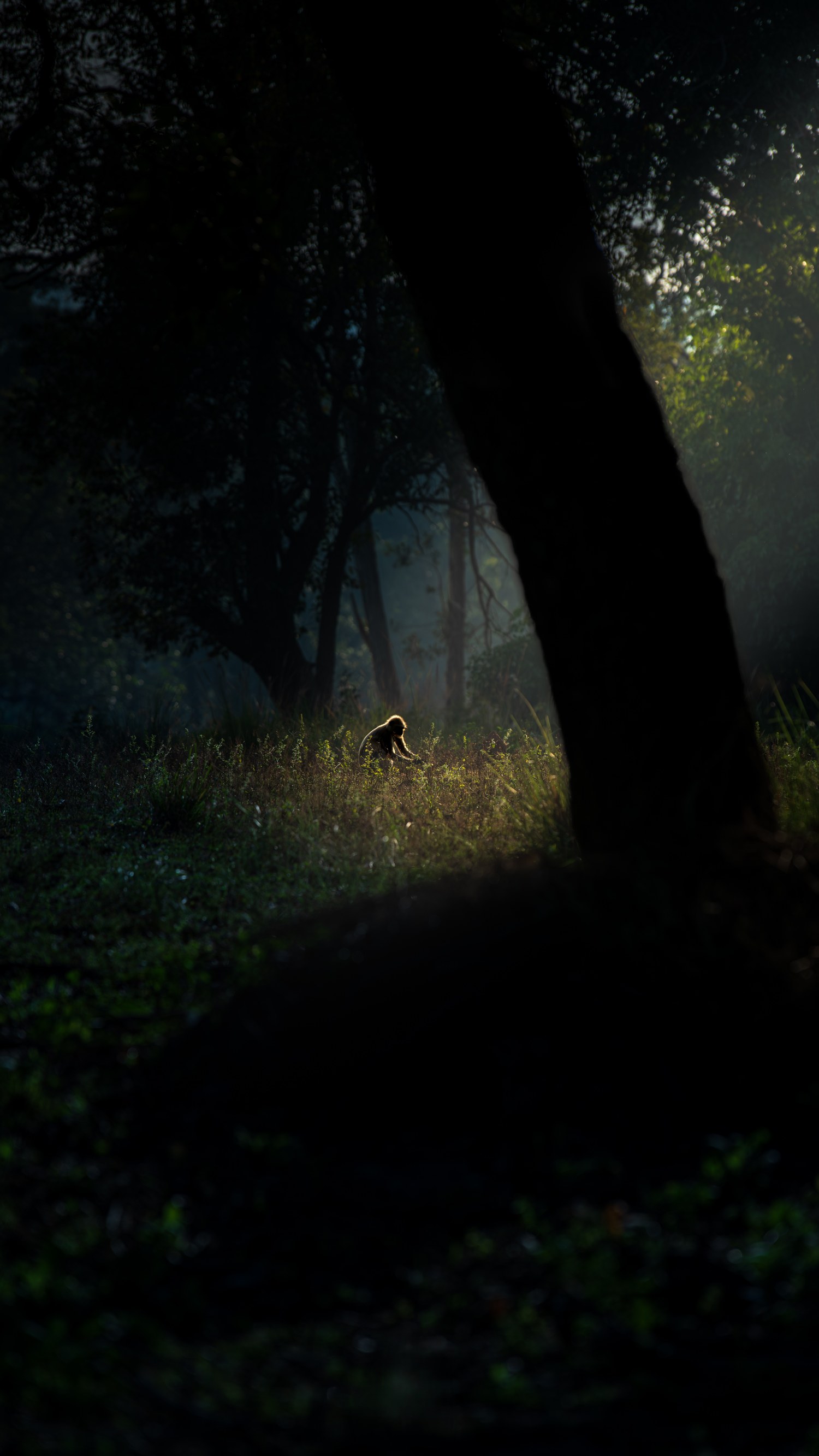
Patiently held — you waited for the macaque to occupy the exact geometric centre of the light shaft, and that decision to commit to the reduction rather than chase a clearer wildlife portrait is what separates this from the thousands of macaque frames made every year.
What is working
Where it stops short
The same five, every time, on the same scale every evaluation uses.
0.9 separates your strongest dimension from your weakest. That gap is where the next evaluation is won.
Where this reading sits against every photograph the engine has read.
This places you in the top 2% of Creative images evaluated on Shutter League. Your how striking the image is to a stranger score of 8.9 is significantly above the Creative average of 6.8 — this means you are making compositional decisions that break from convention in ways that most photographers in this genre do not attempt, and that disruption is what separates award-level work from competent execution.
“Brilliantly reduced — you found the exact relationship between subject, light, and void that makes this frame singular.”
Composition · Negative space
Why this score. Finding a macaque in a narrow shaft of golden light inside a dense forest, holding the exposure to preserve both the lit subject and the surrounding shadow without clipping either extreme, and waiting for the animal to remain still in that exact position — this is the compositional precision that minimalist wildlife work demands, and it was executed cleanly.
Why this score. A macaque treated as a geometric study in negative space — a living subject reduced to a single point of light in a vast dark frame — breaks every convention of wildlife portraiture and documentary, where the expectation is to show the animal clearly, identify it, and fill the frame with its presence.
Why this score. The moment when the macaque's posture and the light shaft aligned — head tilted down, body compact, the animal occupying the exact geometric centre of the illuminated patch — is the peak of this minimalist composition, and the photographer held the frame at that instant.
Why this score. Eye Wonder at its highest level — the photographer found a compositional relationship between subject, light, and shadow that transforms a common primate into a singular visual statement, and the image could not exist if the photographer had moved half a metre or changed the exposure by half a stop.
Why this score. Stillness — the specific feeling of suspension, of a creature pausing in a moment of private attention, unaware of being watched, and the viewer feels the quiet of that forest interior and the privilege of witnessing something that was not performed for the camera.
Standard edit · balanced
Darken the upper right corner by one stop — the bright patch of canopy is competing with the macaque for the viewer's attention, and removing that competition makes the subject the undeniable focus.
Increase contrast in the shadow areas by 5-10% — the surrounding forest is currently a uniform black, and adding subtle tonal variation (tree trunks barely visible, ferns at the edge of perception) gives the negative space depth without breaking the minimalist reduction.
Warm the golden light on the macaque by 100-150K — the light is already warm, but pushing it slightly further separates the subject from the cool shadows and reinforces the tonal relationship that makes the reduction work.
Creative edit · artistic
Convert to black and white and push the contrast to maximum — remove all colour information and render the image as pure light and shadow, with the macaque as a white silhouette against a black void. This transformation changes the emotional register from stillness to absence, from a moment observed to a memory half-forgotten, and the image becomes a study in what remains when everything else is stripped away.
Now open
BR Hills (Biligirirangana Hills) is about 3.5 hours from you. Elephant herds are moving through the reserve in the wet season, and sloth bear sightings are increasing as fruiting trees come into season. This is the less obvious choice that separates portfolios — less visited than Kabini means less habituated animals, more genuine difficulty, and the kind of access that scores exceptionally on the difficulty dimension. Full day — wet season overcast diffuses the light. Book through Jungle Lodges.
Depth of Difficulty has been your quietest dimension lately. That often means you are in a productive groove — but grooves become ruts. One session deliberately outside your usual parameters would change this.
Across your last 30 photographs, over the past 67 days.
This evaluation is currently based on 3092 calibrated images.