 Shutter LeagueShutter League
Higher than 25% of images in the League
1.52 to go to recognition level (8.5) · best this year 9.08
Use your phone. Stand close. Make two frames: one where they look at you, one where they return to their work. The second frame is the one you are training yourself to see.
YOUR NEXT BODY OF WORK SEQUENCE: The story is daily labor in small-scale commerce — the people who make a city function but remain invisible to most viewers. Frame 1: wide shot of the stall or workspace at dawn, the subject arriving, setting up, the city still quiet. Frame 2: close portrait mid-transaction — hands exchanging money or goods, the subject's face concentrated, the customer partially visible. Frame 3: the subject at the end of the day, counting the day's earnings or closing the stall, exhaustion and satisfaction both visible in the posture.
The photograph you almost made is always better than the one you settled for.
A note on your People eye in a Documentary frame: Your People training gave you the trust-building skill that earned this access — most Documentary photographers struggle to get strangers to meet the camera this directly. The Documentary gap: you stopped at the cooperative portrait instead of waiting for the unguarded moment, and that is the difference between a good frame and a published frame.
Patiently earned — you did not take this frame, you were given it, and that is the access most photographers never achieve with strangers in their workspaces.
What is working
Where it stops short
The same five, every time, on the same scale every evaluation uses.
2.4 separates your strongest dimension from your weakest. That gap is where the next evaluation is won.
Where this reading sits against every photograph the engine has read.
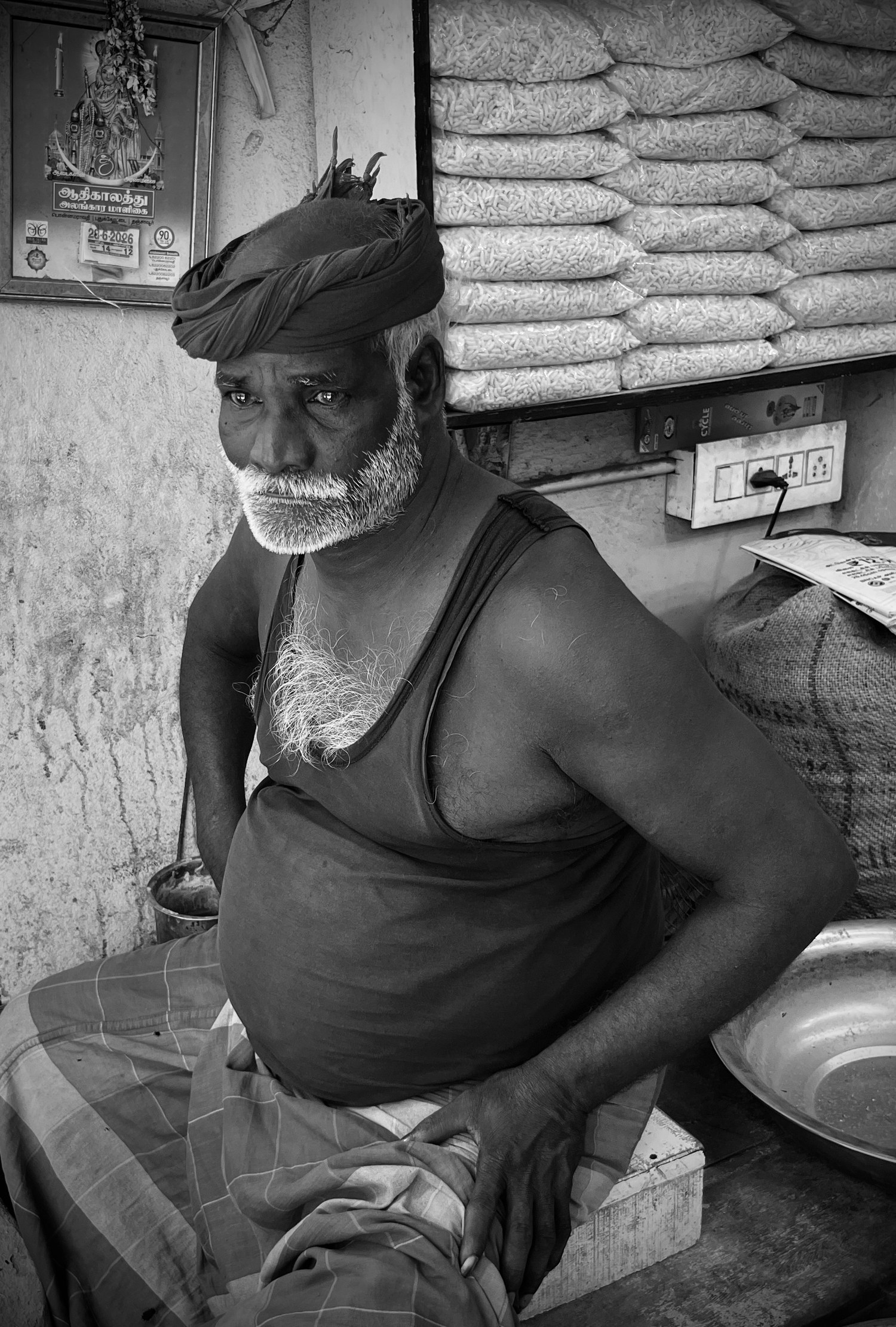
This places you in the top 32% of Documentary images evaluated on Shutter League. Your how striking the image is to a stranger score of 5.8 is below the Documentary average of 6.4 — the direct frontal portrait of a working subject in their workspace is a documentary standard, and the frame needs either an unexpected angle or an unguarded moment to break convention.
“Quietly powerful — you earned the trust that made this frame possible, and the vendor's direct gaze carries the weight of that trust.”
Composition · Rule of thirds
Why this score. The access to photograph a street vendor in his workspace with direct permission and eye contact is genuine trust-based access, but the technical execution on a mobile phone in mixed indoor light with no control over the environment is standard documentary difficulty — not extreme.
Why this score. The direct frontal portrait of a working-class subject in their workspace is a documentary standard — the stacked rice bags and religious calendar add context but the overall framing follows the established visual language of social documentary portraiture.
Why this score. The steady gaze and composed posture are strong, but the moment is a posed cooperation rather than a captured peak — the decisive documentary frame would have been the vendor mid-transaction or mid-gesture, hands active, expression unguarded.
Why this score. Access Wonder scores high — the vendor allowed the camera into his workspace and met the lens directly, creating the trust-based intimacy that most photographers never achieve with strangers in their place of work.
Why this score. Dignity — the subject holds the frame with quiet self-possession, meeting the viewer's gaze without performance or defensiveness, and that specific emotional register of presence without pretense is what makes the image linger.
Standard edit · balanced
Darken the background — the bright rice bags and the electrical socket panel are competing with the subject's face for attention. Bring them down one to one-and-a-half stops so the subject's face becomes the undeniable anchor.
Crop tighter from the left — remove the empty wall space on the left side of the frame and bring the subject closer to the left edge. This shifts the composition from centered to left-third and gives the rice bags more weight as a contextual element.
Dodge the subject's eyes slightly — the catchlight is present but faint. Lifting the brightness in the eyes by a quarter-stop makes the connection between subject and viewer undeniable.
Creative edit · artistic
Convert to a high-contrast, low-key treatment — crush the shadows so only the subject's face, hands, and the outline of the rice bags remain visible, everything else falls into black. This transforms the image from a documentary portrait into a study of presence and labor, where the subject emerges from darkness rather than sitting in a lit room.
Now open
PhotoMuse Festival of Photography 2026 is happening right now in Kodaly, Thrissur — zero travel, you are already there. The festival features documentary photography exhibitions and workshops with national and international photographers, offering access to professional work and diverse perspectives on people photography in a curated cultural setting. Contact PhotoMuse directly for specific 2026 festival dates and venue details. Based on your location (Thrissur) · Genre (Documentary) · Your growth opportunity (trust-based access)
Across your last 25 photographs, over the past 4 months.
This evaluation is currently based on 3092 calibrated images.