 Shutter LeagueShutter League
Higher than 24% of images in the League
1.63 to go to recognition level (8.5) · best this year 9.14
Bring a small LED panel or use window light if you are indoors. Light the hands and the task, but leave enough ambient exposure that the background is visible, not black. Shoot the task first. Then wait for the pause.
YOUR NEXT BODY OF WORK SEQUENCE: The story is the morning ritual — the small acts that start the day for people who work with their hands. Frame 1: the hands preparing — chopping, pouring, lighting a fire, the task in progress with the face not yet visible. Frame 2: the face — the moment when the person pauses, looks up, reacts to something, and you see who they are instead of what they are doing. Frame 3: the result — the cup of tea handed to someone, the food plated, the fire settled, the frame that shows what the work was for. Three frames. One story. The work, the worker, the reason.
The camera is just the tool. The real instrument is your attention — and you are learning to hold it on the small moments that most people walk past. That is the whole practice.
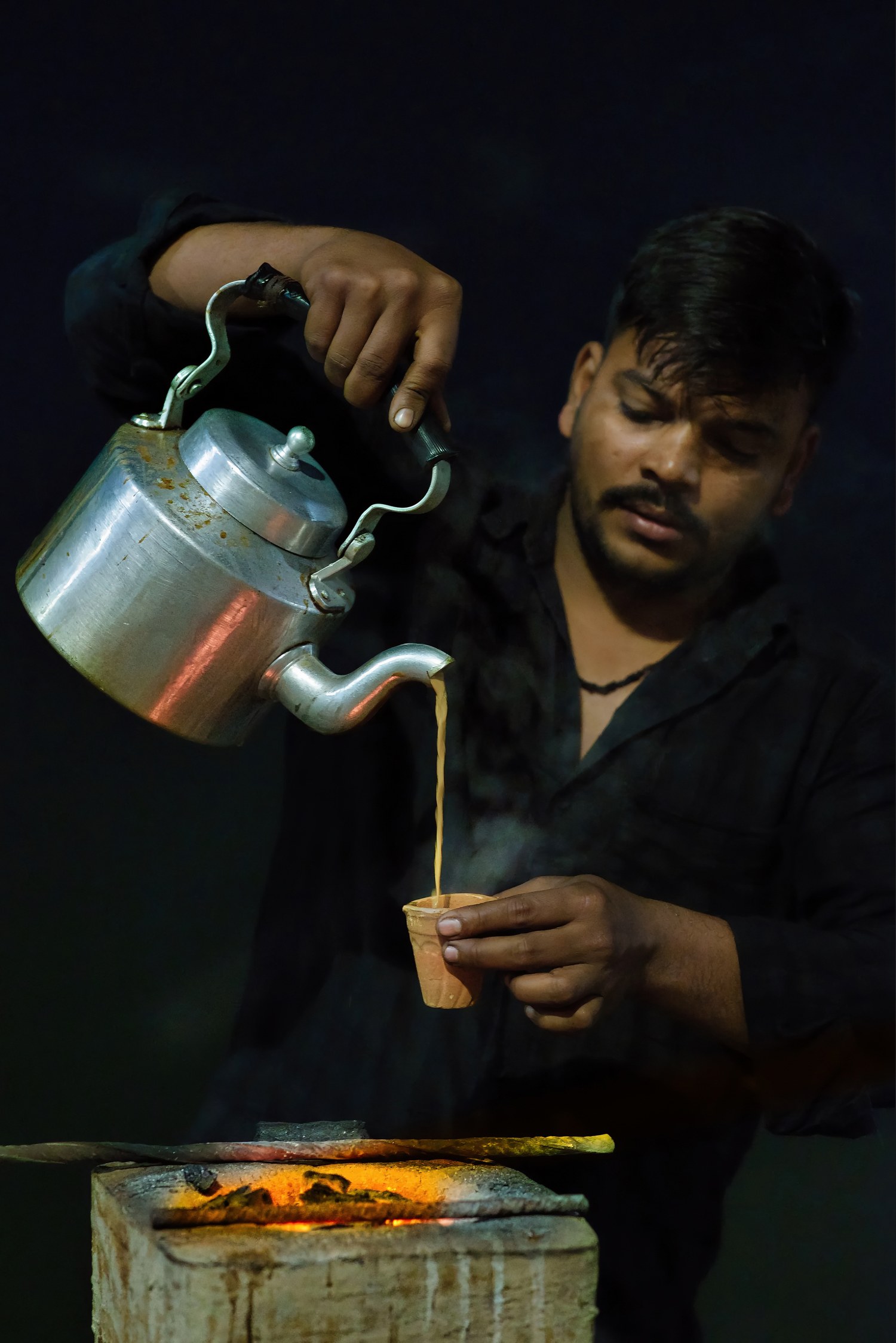
Quietly deliberate — you made a lighting decision that most street photographers at this scene would not have made: you isolated the subject against black and lit only the hands, the kettle, and the pour. That is a portrait choice, not a documentary choice, and it separated this frame from the thousands of tea-vendor images shot in available light every day.
What is working
Where it stops short
The same five, every time, on the same scale every evaluation uses.
2.5 separates your strongest dimension from your weakest. That gap is where the next evaluation is won.
Where this reading sits against every photograph the engine has read.
This places you in the top 38% of Street images evaluated on Shutter League. Your how striking the image is to a stranger score of 5.8 is slightly below the Street average of 6.2 — the lighting control and the frozen pour are strong, but the black background treatment is familiar from thousands of artisan portraits, and the next step is finding a visual angle or a contextual detail that makes this frame feel singular rather than well-executed.
“Tenderly seen — you stopped for a moment most people walk past and gave it the light and attention it deserved.”
Composition · Negative space
Why this score. Pouring tea from a kettle into a clay cup over an open fire is a daily act in millions of Indian households — the difficulty here is in the lighting control and the decision to isolate the moment against black, not in the access or the rarity of the scene itself.
Why this score. The black background and dramatic side lighting push this away from documentary realism toward portraiture — but the treatment is familiar from thousands of artisan and street vendor portraits shot this way across India.
Why this score. The pour is frozen mid-stream with visible steam rising — the precise instant where the liquid arc is clean and the subject's focus is complete, and that window is narrow and was captured.
Why this score. The image shows a daily ritual with care and attention — the wonder is in the photographer's decision to light and frame it as significant rather than in the act itself, which is ordinary and repeatable.
Why this score. Quiet dignity — the subject is absorbed in the task, the light is warm, the moment feels tender and unhurried, and that specific feeling of care in a small daily act lands clearly.
Standard edit · balanced
Lift the shadows on the face by one stop — the hands and the kettle are beautifully lit, but the face is lost in darkness. Bringing the face into visibility without blowing the highlights on the kettle would make this a portrait instead of a task study.
Crop tighter from the top — the empty black space above the subject's head is not adding anything. Bringing the top edge down to just above the head would tighten the composition and make the subject feel more present.
Warm the colour temperature slightly — the fire glow is warm but the overall image feels neutral. Pushing the warmth by 200-300K would make the light feel more like firelight and less like studio light.
Creative edit · artistic
Convert to black and white and push the contrast hard — remove the warmth entirely and make this about the geometry of the hands, the kettle, and the pour. The steam becomes a graphic element instead of a soft haze, and the image shifts from tender to stark. It would lose the warmth but gain a different kind of dignity — the dignity of labour instead of the dignity of care.
Now open
Chamundeshwari Temple in Mysore is 2 hours from you — the early morning puja preparation between 06:00-07:30 has priests lighting oil lamps, pouring milk offerings, and arranging flowers in low temple light with smoke from incense creating natural atmosphere. The light is warm, the gestures are ritualistic and repeating, and the faces are often lit from below by the lamps. Wait for the pause between tasks — that is when the expression shifts from duty to devotion, and that is the frame that separates documentation from portraiture.
You have been shooting within your comfort zone recently. The Depth of Difficulty readings suggest familiar subjects in familiar light. The next level of your work probably requires deliberately harder conditions.
Across your last 30 photographs, over the past 43 days.
This evaluation is currently based on 3092 calibrated images.