 Shutter LeagueShutter League
Higher than 22% of images in the League
1.7 to go to recognition level (8.5) · best this year 9.14
are present but the light is still low and directional. Position yourself so the light rakes across carved stone, painted walls, or architectural detail, and wait for a human subject to move into a position where their gesture or posture echoes the architecture. Shoot at ISO 400, 1/125s or faster, and use the Nikon's wide-angle capability to hold both the person and the architectural context in one frame.
YOUR NEXT BODY OF WORK SEQUENCE: The story is the living relationship between Bangalore's communities and their sacred spaces. Frame 1: a woman lighting a lamp at dawn inside a Malleswaram temple, the flame illuminating her face and the carved deity behind her. Frame 2: a man reading namaz on a prayer mat in a Shivajinagar mosque courtyard, the geometric tile pattern beneath him and the arched colonnade framing him symmetrically. Frame 3: an elderly woman sitting alone on a church pew in Fraser Town, the stained glass window behind her casting coloured light across her hands folded in her lap — the frame that stays with you because it is about solitude and faith, not just the building.
The camera is just the tool. The real instrument is your attention.
A note on your Street eye in a Documentary frame: Your Street training gave you the instinct to include the human presence and wait for the smile — that is visible in the AQ score of 7.4. Documentary demands more deliberate geometric composition and a stronger relationship between subject and environment — the one drill that closes the gap is to pre-visualise the frame before the subject arrives, then wait for them to move into it.
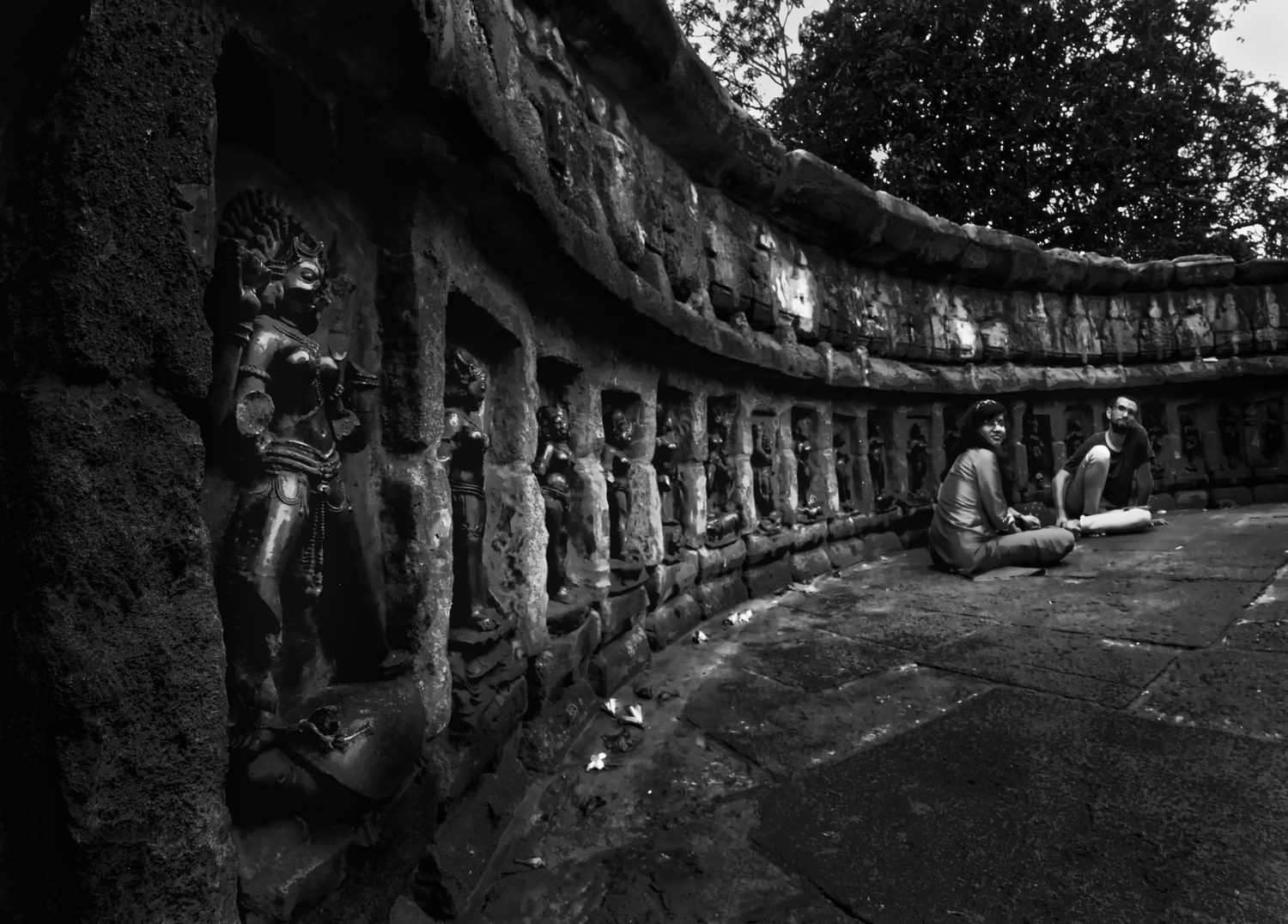
Thoughtfully layered — you did not just photograph the carved stone deities, you photographed the human relationship to them, and that is the Documentary decision that most heritage photographers miss.
What is working
Where it stops short
The same five, every time, on the same scale every evaluation uses.
2.0 separates your strongest dimension from your weakest. That gap is where the next evaluation is won.
Where this reading sits against every photograph the engine has read.
This places you in the top 42% of Documentary images evaluated on Shutter League. Your how striking the image is to a stranger score of 5.8 is slightly below the Documentary average of 6.2 — the wide-angle temple frame with visitors is a familiar treatment, and the one thing that would lift it is a more unexpected angle or a more deliberate geometric relationship between the human subjects and the carved architecture.
“Warmly composed — you found the human moment inside the architecture, and that decision is what separates this from a thousand other temple frames.”
Composition · Leading lines
Why this score. Photographing inside a temple courtyard with carved stone deities requires access and compositional patience, but the technical execution is straightforward — wide-angle framing in open daylight with no environmental hostility or restricted access that most photographers could not achieve.
Why this score. The low-angle perspective and the inclusion of the human subjects alongside the carved deities creates a layered frame, but the overall treatment — wide-angle temple documentation with visitors present — is a familiar approach to heritage site photography.
Why this score. The woman's relaxed seated posture and visible smile create a moment of human presence, but the man crouching in the background is partially obscured and the geometric relationship between the two human subjects and the carved wall is not at its compositional peak — a half-step left would have separated them more clearly.
Why this score. Cultural Wonder is present — the carved stone deities in their weathered niches document a specific religious and architectural tradition, and the human presence adds scale and contemporary context to the ancient site, creating a frame that shows the living relationship between people and heritage.
Why this score. The woman's smile and relaxed posture create a feeling of ease and belonging — she is comfortable in this sacred space, and that comfort is readable and specific, creating a gentle connection between the viewer and the scene.
Standard edit · balanced
Darken the upper right corner where the tree foliage is bright and competing with the carved wall — removing that brightness pulls the eye back to the stone deities and the human subjects where the story lives.
Increase contrast slightly in the carved stone niches to emphasise the three-dimensionality of the relief sculptures — the weathered texture and depth of the carvings are part of the cultural story and should be more readable.
Crop tighter from the left edge to remove the partial tree trunk in the foreground — it adds no information and creates visual clutter at the frame edge.
Creative edit · artistic
Convert to a warmer monochrome with lifted shadows and crushed highlights — the image would become about the timelessness of the stone and the continuity of human presence across centuries, rather than the documentary record of a specific moment in colour.
Now open
Someshwara Temple in Ulsoor is 25 minutes from you — the carved stone pillars and the morning light through the open courtyard create strong directional shadows across the architecture, and the temple is active with morning visitors between 06:30 and 08:00. The frame worth making: a devotee lighting a lamp beside a carved pillar, the flame illuminating their face and the stone deity simultaneously, shot from low angle to hold both in one frame.
You have been shooting within your comfort zone recently. The Depth of Difficulty readings suggest familiar subjects in familiar light. The next level of your work probably requires deliberately harder conditions.
Across your last 30 photographs, over the past 43 days.
This evaluation is currently based on 3092 calibrated images.