 Shutter LeagueShutter League
Higher than 27% of images in the League
1.38 to go to recognition level (8.5) · best this year 9.08
om — look for the objects that tell the story when the people are absent: the costume on the hook, the mridangam resting against the wall, the makeup mirror with the chair pushed back. Shoot with your phone's wide lens, get close, and let the object fill the frame.
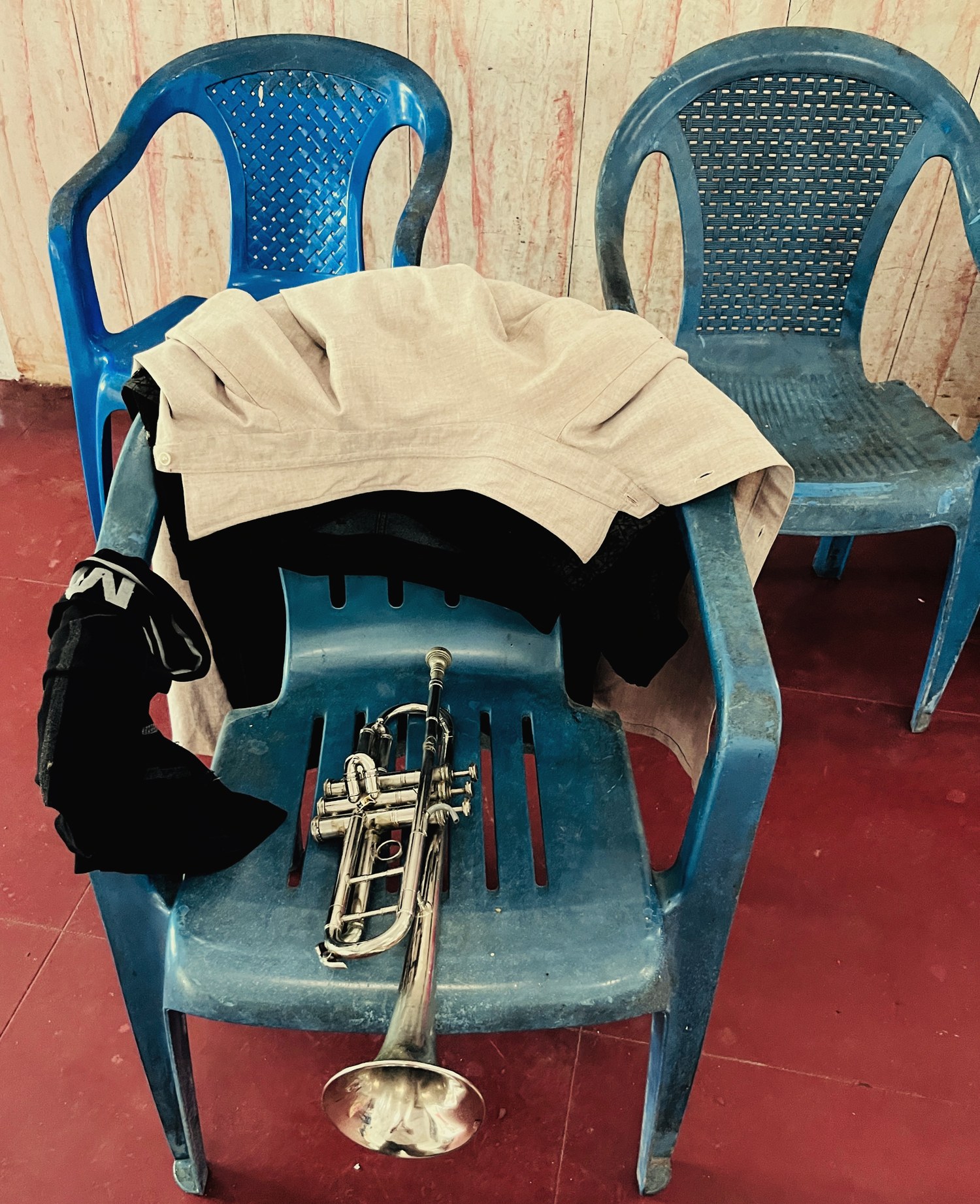
YOUR NEXT BODY OF WORK SEQUENCE: The story is the musician's day in objects, not portraits. Frame 1: the trumpet case open on a bed in morning light, sheet music visible inside. Frame 2: the same trumpet resting on a chair in a waiting area (this image). Frame 3: the empty stage after the performance — music stand, abandoned water bottle, single spotlight still on. Three frames, no people, one complete story.
The photograph you almost made is always better than the one you settled for.
A note on your People eye in a Creative frame: Your People training taught you to read absence as presence — the empty chair beside the trumpet carries the same weight as a portrait would, and that is a skill most Creative photographers have to learn deliberately. The gap: Creative fine art demands light design, and this frame is lit by ambient room light when a single controlled source would have made it unforgettable.
Quietly composed — you saw the narrative in the arrangement of objects and understood that the musician's absence is the subject, not a missing element.
What is working
Where it stops short
The same five, every time, on the same scale every evaluation uses.
1.6 separates your strongest dimension from your weakest. That gap is where the next evaluation is won.
Where this reading sits against every photograph the engine has read.
This places you in the top 22% of Creative images evaluated on Shutter League. Your how striking the image is to a stranger score of 7.8 is above the Creative average of 6.2 — the visual collision between formal instrument and informal setting is doing the work, and that collision is what separates this from a backstage snapshot.
“You found the frame that tells the story without showing the person.”
Composition · Diagonal
Why this score. The conceptual construction is clear — trumpet, clothing, chairs arranged as a still life — but the execution is straightforward documentation rather than complex lighting design or technical challenge that would push DoD higher in fine art.
Why this score. The juxtaposition of a brass instrument with plastic chairs and draped clothing against weathered wood creates a visual collision between the formal (music) and the informal (waiting area) that most photographers would not compose this way.
Why this score. The frame captures the arrangement at rest — the decisive moment in still life is the exact angle and distance where all elements resolve into their strongest relationship, and this frame is close but the trumpet could be more prominent relative to the fabric mass.
Why this score. The image creates a specific world — the backstage waiting moment before a performance — and the viewer feels the absence of the musician, which is a form of narrative wonder, but the emotional register is suggestion rather than full immersion.
Why this score. Anticipation mixed with stillness — the trumpet waits, the clothing waits, and the viewer feels the pause before something begins, which is a specific and nameable emotion that lands clearly.
Standard edit · balanced
Darken the background wall by one stop — the light streaks in the wood are pulling attention away from the trumpet and clothing, and reducing their brightness makes the foreground subjects the clear focus.
Crop tighter from the right edge to remove the empty chair entirely — the narrative is stronger when the absence is absolute rather than implied by a second empty seat.
Lift the midtones on the trumpet bell slightly — it is the visual anchor of the frame and giving it a subtle luminance boost separates it from the blue chair beneath it.
Creative edit · artistic
Convert to black and white with a warm tone (sepia or slight yellow cast) and push the contrast so the trumpet becomes a bright focal point against deep shadows — the image becomes timeless, more about the ritual of performance than the specific moment, and the emotional register shifts from anticipation to nostalgia.
Now open
The Kerala Kalamandalam in Cheruthuruthy is 30 minutes from you — the green rooms and practice spaces during morning rehearsals (07:00-09:00) are filled with costumes, mirrors, and instruments in waiting. The frame worth making: a single kathakali crown resting on a wooden stool with the mirror reflection behind it, natural window light from the left.
Across your last 25 photographs, over the past 4 months.
This evaluation is currently based on 3092 calibrated images.