 Shutter LeagueShutter League
Higher than 27% of images in the League
1.38 to go to recognition level (8.5) · best this year 9.08
f the objects that tell the story of the work. Use your phone's wide-angle lens. Shoot straight down. Look for geometric relationships — diagonals, circles, triangles formed by the objects themselves.
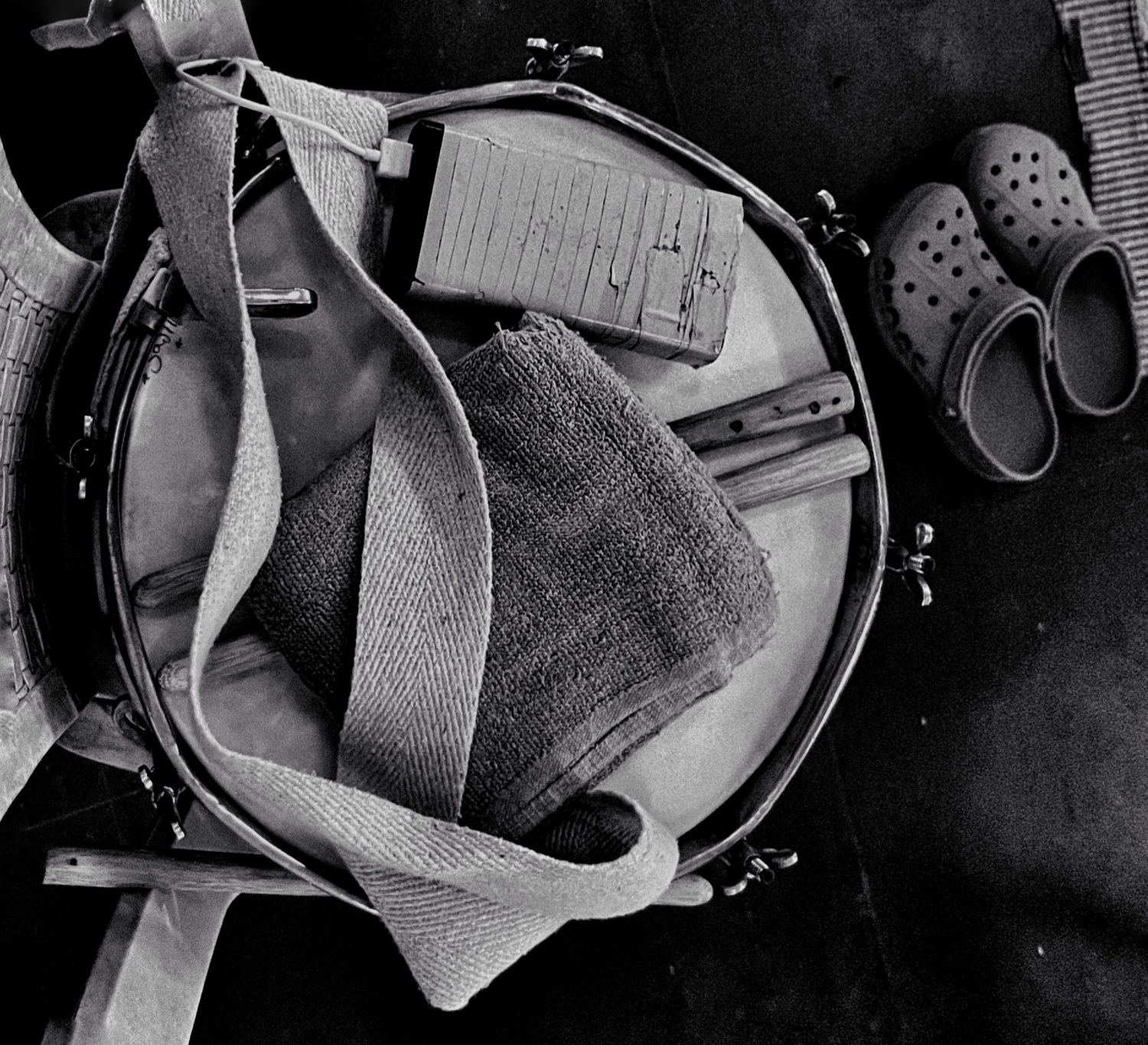
YOUR NEXT BODY OF WORK SEQUENCE: The story is the unseen labour behind Thrissur's cultural life. Frame 1: The brass band musician's rest area (this image) — the drum as container, the worn sandals, the pause between performances. Frame 2: A Pooram preparation scene — the elephant caparison being assembled on the ground, the gold ornaments laid out in geometric patterns, the hands of the craftspeople visible but not their faces. Frame 3: The frame after the event — the empty street at dawn, the discarded flower garlands, the single dropped drumstick, the evidence of what happened without showing the event itself. This is the editorial story that shows the cultural moment through its objects, not its spectacle.
The camera is just the tool. The real instrument is your attention — and you are training it to notice what most people walk past.
A note on your People eye in a Creative frame: Your People training gave you the patience to wait for the right arrangement and the instinct to find dignity in worn objects — that is visible in the AQ score of 7.6. The Creative gap: the geometric precision of the overhead angle is strong, but the tonal execution is not yet earning the mood — pull the exposure down and let the shadows go near-black to create the atmosphere the subject deserves.
Patiently composed — you found the overhead angle that transforms a musician's rest area into a geometric study, and you waited for the arrangement to resolve before opening the shutter. Most documentary photographers at a brass band event shoot the performance. You shot the pause.
What is working
Where it stops short
The same five, every time, on the same scale every evaluation uses.
1.1 separates your strongest dimension from your weakest. That gap is where the next evaluation is won.
Where this reading sits against every photograph the engine has read.
This places you in the top 28% of Creative images evaluated on Shutter League. Your how striking the image is to a stranger score of 7.2 is above the Creative average of 6.8 — you are making compositional decisions that depart from conventional documentation, and the overhead still-life treatment is what separates this from a standard backstage record shot.
“Respectfully observed — you found the frame that shows a musician's world without the musician needing to be present.”
Composition · Diagonal
Why this score. The compositional precision of finding this exact overhead angle — where the drum becomes a container, the straps create diagonal tension, and the sandals anchor the right edge — required deliberate positioning and a clear pre-visualised frame, but the subject itself is stationary and accessible, limiting the situational difficulty.
Why this score. The overhead still-life treatment of a musician's rest-area objects — drum as container, not instrument — departs from conventional brass band documentation, but the black-and-white aesthetic and geometric framing follow established documentary still-life traditions rather than breaking new visual ground.
Why this score. The frame captures the arrangement at a moment of visual balance — straps crossing the drum at their strongest diagonal, sandals positioned to anchor the composition — but this is a constructed still-life where the photographer controlled the arrangement, so the decisive moment is the compositional decision rather than a fleeting temporal peak.
Why this score. The image reveals the unseen backstage reality of a brass band musician — the drum repurposed as storage, the worn sandals, the folded towel — creating access wonder by showing a world most viewers never enter, and the overhead perspective transforms ordinary objects into a geometric study that holds the eye.
Why this score. The image creates a specific feeling of pause — the stillness before or after performance, the quiet intimacy of a musician's personal space, the dignity in worn objects that serve their purpose — and that feeling of respectful observation, of being allowed to see something private without intrusion, is what makes the image linger.
Standard edit · balanced
Darken the floor by one full stop — let the background go near-black while holding the strap and towel detail. This creates the atmosphere of a backstage rest area rather than a neutrally-lit still-life. The image earns its mood instead of borrowing it from the conversion.
Crop tighter on the left edge — remove the excess floor space and bring the left drum rim closer to the frame edge. This tightens the composition and makes the drum feel larger and more present.
Increase the contrast slightly in the drum head texture — the worn surface and the rectangular object (rosin block or wooden case) resting on it have detail that is currently too subtle. Bring that texture forward without crushing the shadows.
Creative edit · artistic
Convert to a high-contrast graphic treatment — pure black floor, pure white straps, the drum and sandals rendered as mid-tone shapes with no texture. This transforms the documentary still-life into a formal graphic study where the geometry becomes the entire subject. The image becomes about pattern and shape rather than the story of the musician.
Now open
The Swaraj Round in Thrissur is 15 minutes from you — the street vendors set up their stalls at dawn, and the overhead still-life of their preparation work (vegetables arranged in geometric patterns, tools laid out on cloth, the hands assembling the display) is the same discipline you applied here. Shoot between 06:00-07:00 when the light is soft and the vendors are still arranging their goods. The frame worth making: the overhead view of a flower vendor's basket being assembled, the marigolds and jasmine creating concentric circles of colour against the woven cane.
Across your last 25 photographs, over the past 4 months.
This evaluation is currently based on 3092 calibrated images.