 Shutter LeagueShutter League
Higher than 60% of images in the League
0.56 to go to recognition level (8.5) · best this year 9.14
n waiting. Shoot with your 85mm at f/2.8, but this time: kneel or sit so the camera is at their exact eye level. The perspective shift is the entire assignment.
YOUR NEXT BODY OF WORK SEQUENCE: The story is Invisible Bangalore — the people the city walks past. Frame 1: a wide shot of a busy street intersection at rush hour, pedestrians crossing in all directions, the chaos of movement. Frame 2: a close portrait of one person sitting still in that same intersection — a vendor, a beggar, someone in a wheelchair — shot from their eye level with direct gaze, the background blurred. Frame 3: the hands — what they are holding, what they are doing, the detail that tells you how they survive. Three frames. One story. The city that does not stop, and the person it does not see.
The camera is just the tool. The real instrument is your attention.
Quietly powerful — you earned trust from someone most photographers would walk past, and that access created a frame of dignity rather than documentation.
What is working
Where it stops short
The same five, every time, on the same scale every evaluation uses.
1.9 separates your strongest dimension from your weakest. That gap is where the next evaluation is won.
Where this reading sits against every photograph the engine has read.
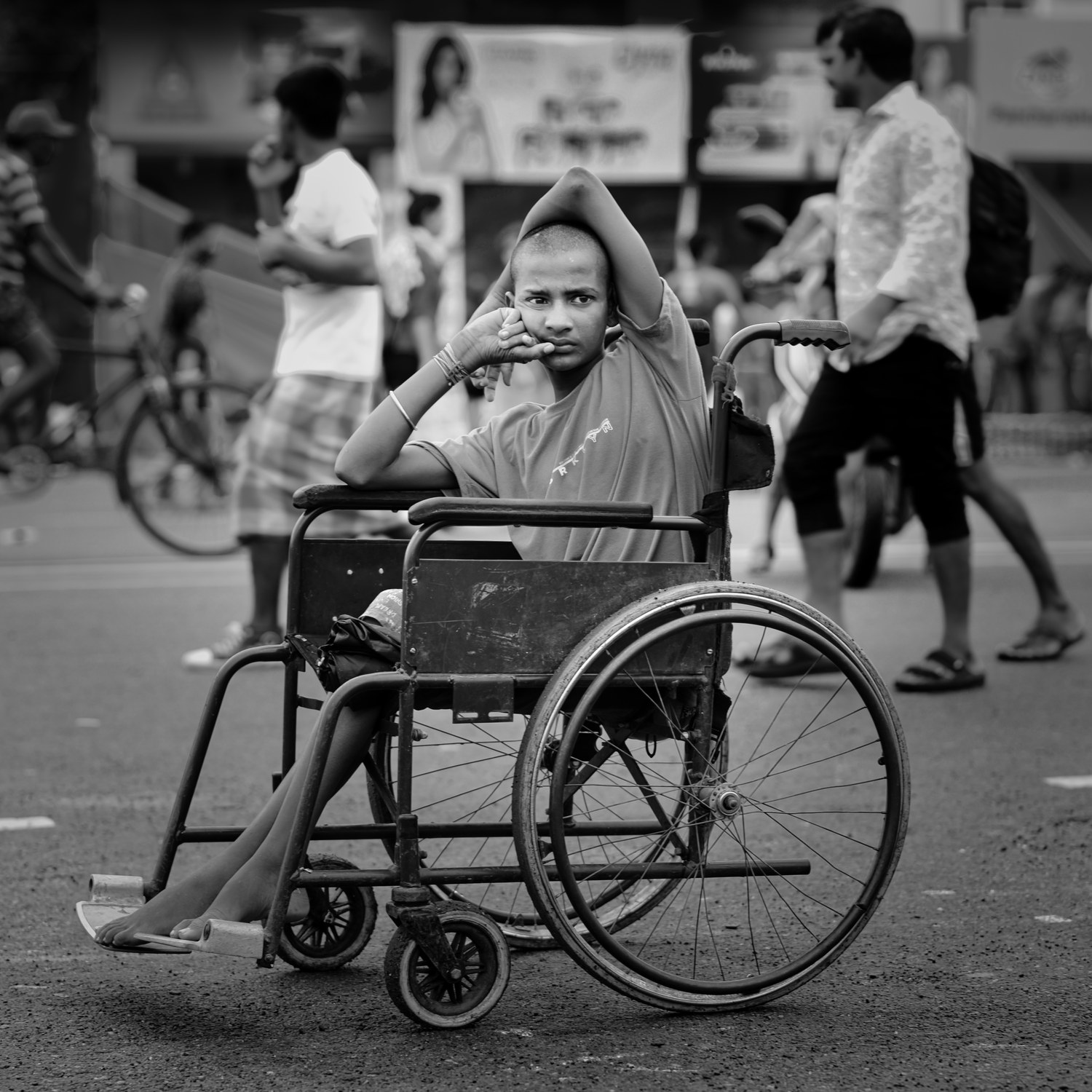
This places you in the top 18% of Documentary images evaluated on Shutter League. Your how striking the image is to a stranger score of 6.8 is slightly below the Documentary average of 7.1 — the direct gaze and the social commentary are strong, but the centred composition and the motion-blurred background follow familiar documentary portrait convention rather than breaking it.
“Quietly powerful — you earned trust from someone most photographers would walk past, and that access created a frame of dignity rather than documentation.”
Composition · Rule of thirds
Why this score. Photographing a person in a wheelchair on a busy Bangalore street with direct eye contact and composed posture requires trust and social access that most photographers never achieve — the difficulty is in the human permission, not the camera settings.
Why this score. The direct gaze and centred composition follow documentary portrait convention — the disruption is in the subject's self-possession and the title's social commentary, not in the visual treatment itself.
Why this score. The moment captures the subject's direct gaze and composed posture simultaneously — the decisive frame would have been this same gaze with the background pedestrians frozen mid-stride rather than blurred, creating sharper narrative tension between stillness and motion.
Why this score. Access Wonder — the photographer was trusted by someone most people walk past without seeing, and that trust created a frame of dignity and presence that documentary work at this level demands.
Why this score. Dignity — the subject looks directly at the viewer with calm self-possession, neither asking for sympathy nor performing for the camera, and that specific emotional register of quiet sovereignty is what makes the image linger.
Standard edit · balanced
Darken the upper left corner and the bright background signage — the bright patches are competing with the subject's face for the viewer's eye, and removing that competition makes the gaze the undeniable focus.
Increase contrast slightly on the subject's face and upper body — the soft light is correct but a small lift in local contrast will separate the subject from the background more cleanly and make the direct gaze land harder.
Crop tighter from the bottom — remove the lower third of the wheelchair wheels and bring the bottom edge up to just below the footrest, which tightens the frame and removes empty asphalt that adds no narrative weight.
Creative edit · artistic
Convert to high-contrast black and white with crushed shadows and held highlights — the soft documentary register becomes a stark social statement, and the subject's gaze shifts from quiet dignity to defiant presence. The image stops asking for empathy and starts demanding recognition.
Now open
Russell Market in Shivajinagar is 20 minutes from you — early morning between 06:30 and 08:00, the vendors are setting up and the light is soft and directional through the market roof. Shoot the flower sellers and the meat vendors at their eye level — kneel, sit on a crate, get low. The frame worth making: a vendor's hands arranging marigolds with their face just visible in the background, sharp and lit, the chaos of the market blurred behind them.
You have been shooting within your comfort zone recently. The Depth of Difficulty readings suggest familiar subjects in familiar light. The next level of your work probably requires deliberately harder conditions.
Across your last 30 photographs, over the past 43 days.
This evaluation is currently based on 3092 calibrated images.