 Shutter LeagueShutter League
Higher than 48% of images in the League
1.02 to go to recognition level (8.5) · best this year 9.13
Set your phone on a stable surface or tripod, use night mode or a long-exposure app, and frame the scene with the horizon in the lower third. Wait. The storm will give you multiple attempts — take them all, then choose the one where the bolt and the cloud illumination are both at peak.
YOUR NEXT BODY OF WORK SEQUENCE: The story is the storm as it arrives, peaks, and passes. Frame 1: the dark cloud mass building on the horizon before the first strike — the anticipation. Frame 2: this frame — the bolt at full extension, the city beneath it, the power made visible. Frame 3: the aftermath — wet streets reflecting city lights, the sky clearing, the calm after the event. Three frames that together show the arc of the storm, not just the peak.
The camera is just the tool. The real instrument is your attention.
A note on your Wildlife eye in a Nature frame: Your Wildlife training gave you the patience to wait for the peak moment — that decisiveness is visible in the 8.5 timing score. The gap to 8+ overall is compositional — Wildlife rewards the subject sharp and centered, Nature rewards the phenomenon framed with intention and the dead space removed.
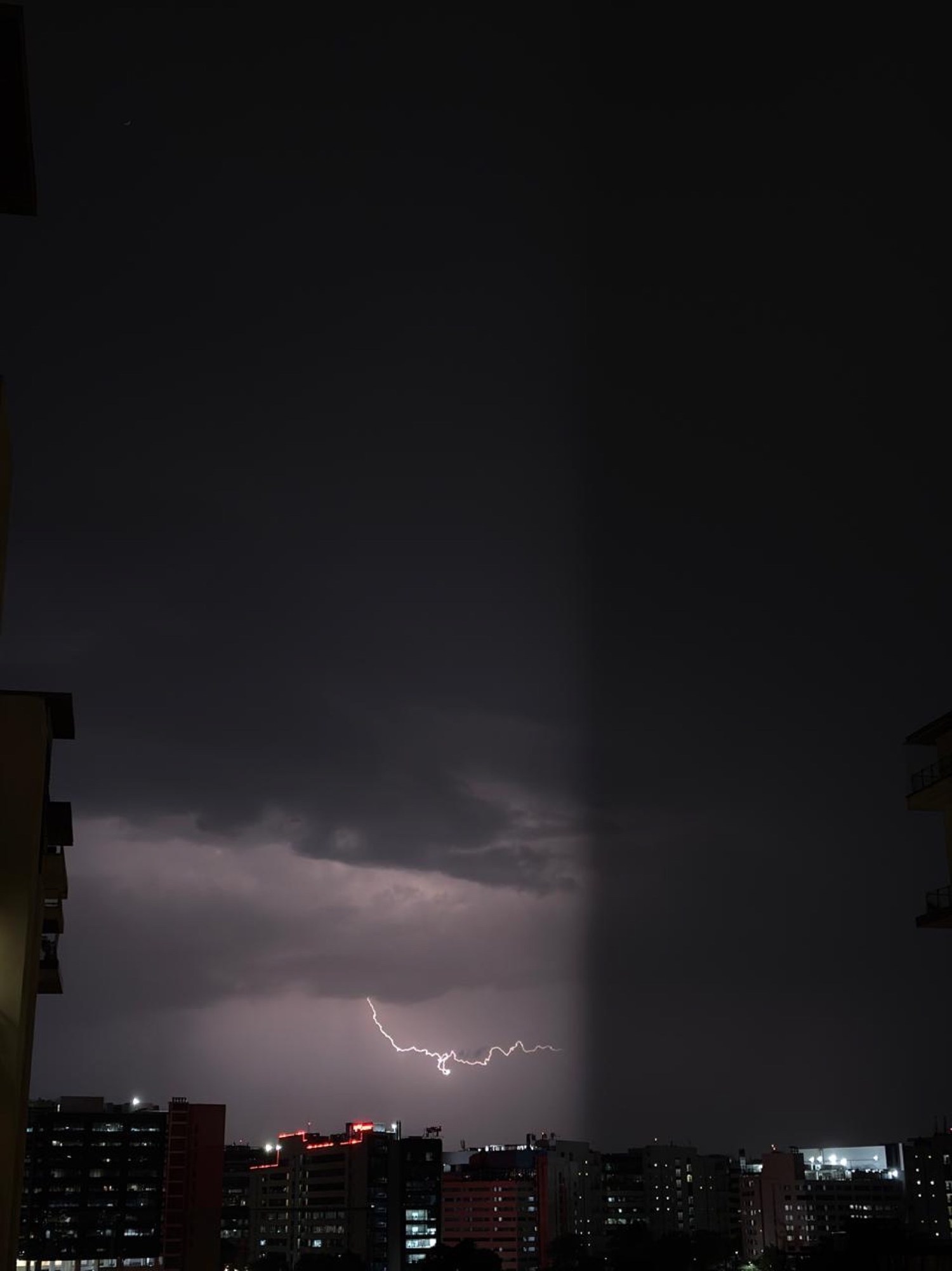
Exceptionally patient — you waited through the storm for the frame where the bolt was fully extended, the branches visible, and the cloud illumination at peak. Most photographers take the first strike and leave. You stayed for the right one.
What is working
Where it stops short
The same five, every time, on the same scale every evaluation uses.
1.7 separates your strongest dimension from your weakest. That gap is where the next evaluation is won.
Where this reading sits against every photograph the engine has read.
This places you in the top 22% of Nature images evaluated on Shutter League. Your evaluation uses Mobile League weights — Decisive Moment and Visual Disruption are weighted more heavily than in Camera League, recognising that these qualities are harder to achieve on a phone. The effort to get this frame is part of what this evaluation is measuring. Your how striking the image is to a stranger score of 6.8 is slightly below the Nature average of 7.2 — the bolt is dramatic but the centered composition and the visual dead space in the upper frame keep it from feeling fully resolved as a photograph rather than a record.
“Perfectly timed — you caught the lightning bolt at full extension with every branching channel sharp and the cloud illumination at its absolute peak.”
Composition · Rule of thirds
Why this score. Capturing a lightning bolt at full extension from an urban vantage point requires patience, timing, and the technical discipline to hold exposure settings stable through multiple attempts — the situational difficulty is moderate (urban access, storm present but not extreme weather), the technical difficulty is high (long exposure timing, exposure balance between bolt and city lights).
Why this score. The horizontal branching discharge across the lower third of the frame is visually striking but the overall treatment — storm over city skyline, bolt centered — follows the established visual language of urban lightning photography rather than breaking it.
Why this score. The bolt is captured at full extension with every branching channel visible and the cloud illumination at peak — this is the decisive frame for lightning photography, the moment when the discharge is complete and the light has reached maximum intensity before fade.
Why this score. The image reveals a natural electrical phenomenon at its most dramatic — the branching structure of the discharge, the cloud illumination, the scale of the event relative to the city — this is Access Wonder (being present with equipment ready when the storm arrived) combined with the technical patience to capture the peak moment.
Why this score. The feeling is awe mixed with unease — the power of the storm made visible, the city small beneath it, the viewer placed at a safe distance but close enough to feel the scale of the event — the emotion is specific and the image delivers it cleanly.
Standard edit · balanced
Crop tighter — remove the upper third of black sky and bring the bolt and illuminated cloud mass up in the frame. The energy concentrates and the composition resolves. The viewer feels closer to the storm.
Darken the city lights slightly — the red rooftop structures and lit windows are competing with the bolt for attention. Pulling them down half a stop makes the lightning the undisputed subject.
Increase contrast in the cloud mass — the gradient from black to illuminated is present but subtle. A small contrast boost in the mid-tones makes the storm structure more readable and adds depth to the sky.
Creative edit · artistic
Convert to black and white with a blue filter simulation — the bolt becomes pure white against deep black, the cloud structure becomes sculptural, and the city lights become small points of warmth. The image shifts from documentary to elemental — the storm as a force, not an event.
Now open
Nandi Hills is about 60 minutes from you — the monsoon is active now and the hills get dramatic storm activity in the late afternoon. Position yourself at the viewpoint facing west before sunset. The storms roll in from the valley and the lightning strikes are frequent and close. Frame with the valley below and the storm above. The frame worth making: the bolt striking down into the valley with the layers of hills visible through the rain.
Decisive Moment has been your most persistent challenge. The moment you are capturing is close to the peak — but consistently arriving a fraction early or late. Start staying with subjects longer than feels comfortable. The frame you want comes after the obvious one.
Across your last 30 photographs, over the past 3 months.
This evaluation is currently based on 3092 calibrated images.