 Shutter LeagueShutter League
Higher than 21% of images in the League
1.76 to go to recognition level (8.5) · best this year 9.14
ual labour is visible — arrive before the work begins. Watch the rhythm. Identify the peak of effort in the cycle. Wait for that moment. Shoot at 1/250s or faster to freeze the body at maximum tension. The pause after effort is equally valid — the worker straightens, breathes, and the resignation is visible in the posture.
YOUR NEXT BODY OF WORK SEQUENCE: The story is the invisible economy — the labour that feeds a city. Frame 1: wide shot of the market or harbour at dawn, the scale of the operation, the piles of goods, the workers as small figures in a larger system. Frame 2: the human moment — one worker at the peak of effort, the body bent, the hands gripping, the face visible or obscured but the posture carrying the entire weight. Frame 3: the pause — the worker at rest, sitting on a cart or leaning against a wall, the tools or goods beside them, the frame that stays with you after you close the book.
The camera is just the tool. The real instrument is your attention.
You returned to this image and re-edited it. That is the habit that separates photographers who improve from photographers who move on. Most people shoot, upload, and forget. You are refining.
What is working
Where it stops short
The same five, every time, on the same scale every evaluation uses.
2.6 separates your strongest dimension from your weakest. That gap is where the next evaluation is won.
Where this reading sits against every photograph the engine has read.
This places you in the top 32% of Documentary images evaluated on Shutter League. Your how striking the image is to a stranger evaluation of 5.2 is below the Documentary average of 6.1 — the selective colour treatment is familiar rather than disruptive, and full monochrome would be the stronger choice for this subject.
“The previous advice suggested removing the selective green entirely and committing to full monochrome.”
Composition · Leading lines
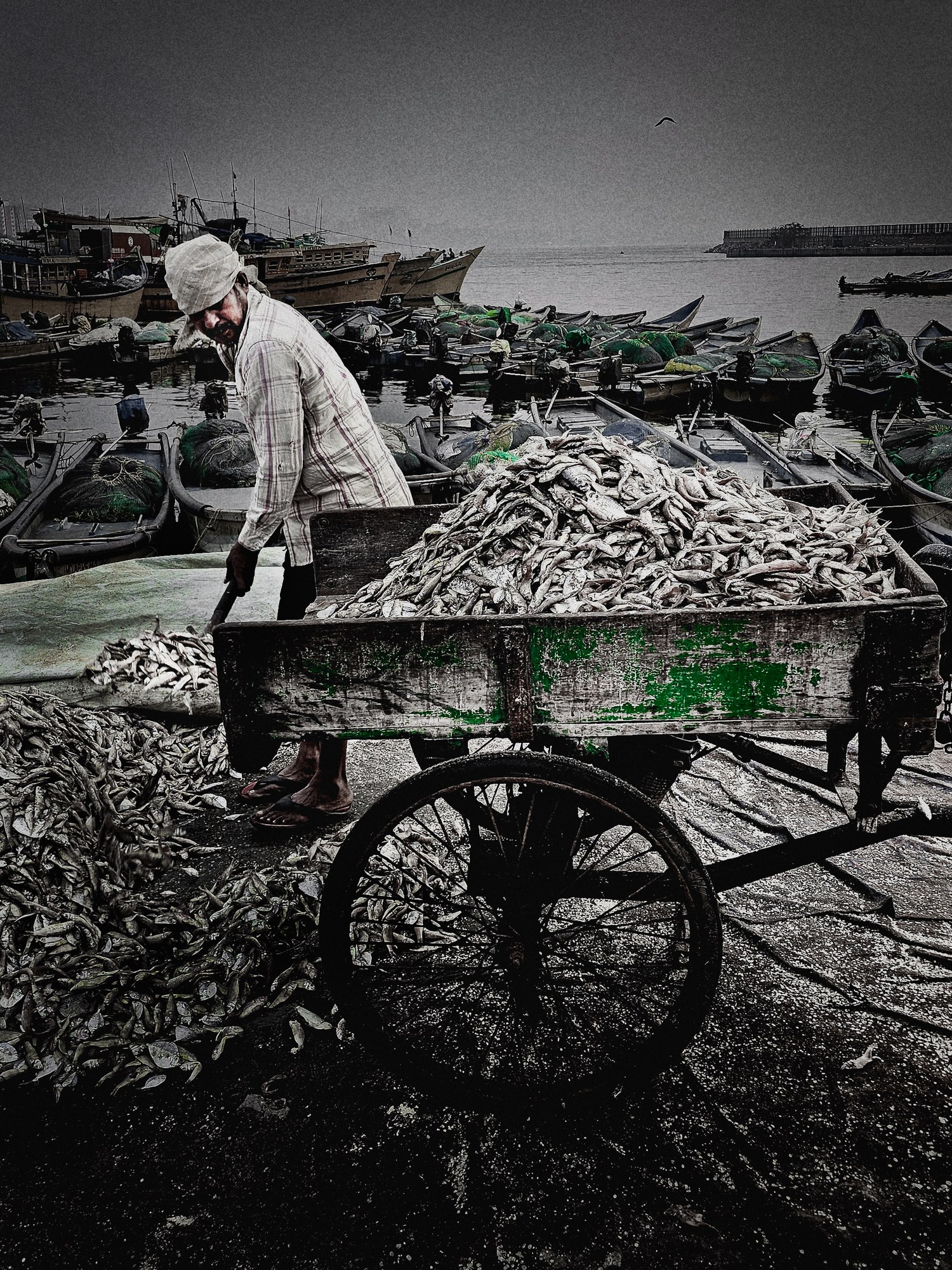
Why this score. Being present at a working fishing harbour during the unloading hour requires access to a commercial space most photographers never enter, and the photographer held position long enough to capture the worker mid-stride with the cart — the difficulty is in the access and the patience, not in the technical execution.
Why this score. The monochrome treatment with selective green retention on the cart and boats is a familiar processing choice in documentary work — the overall composition follows conventional documentary framing with the worker as the clear subject against the harbour background.
Why this score. The worker is mid-stride, leaning into the cart, but the moment is transitional — the decisive frame was either the full lean with maximum body tension or the pause at the end of the push, and neither was captured here.
Why this score. Cultural Wonder — the image documents the physical labour of a fishing community and the daily rhythm of the catch economy; the viewer sees a world most will never enter, and the access to the working harbour at the unloading hour is genuine.
Why this score. Resignation — the worker moves through the frame with the rhythm of daily repetition, no eye contact, no pause, just the next cart to push; the feeling is specific and the image holds it, but the selective colour treatment softens the emotional weight rather than sharpening it.
Standard edit · balanced
Remove the selective green entirely — commit to full monochrome. The green cart and boats are fragmenting the visual unity. The eye jumps between colour and desaturation. Full monochrome lets the tonal contrast between the worker, the fish, and the sky carry the entire emotional weight without competition.
Darken the upper left sky and the background boats by one full stop. They are too bright and compete with the worker for visual weight. The worker should be the darkest mass in the frame, anchoring the eye. Everything else recedes.
Increase contrast on the worker and the cart by half a stop. The worker becomes the clear tonal anchor. The fish piles and the cart wheels lead to that single human figure.
Creative edit · artistic
Crop to a vertical 4:5 frame — remove the right third of the image entirely, keeping only the worker, the cart, and the immediate fish piles. The harbour background disappears. The image becomes a portrait of labour, not a document of a place. The worker fills the frame. The resignation becomes the only subject.
Now open
Russell Market is 20 minutes from you. The flower auction runs from 05:30 to 07:00 every morning — workers unloading baskets, sorting blooms, the entire floor covered in marigolds and roses. Arrive at 05:45. The light is soft, the action is at its peak, and the frame worth making is the worker bent over a basket with the flower piles leading to them.
You have been shooting within your comfort zone recently. The Depth of Difficulty readings suggest familiar subjects in familiar light. The next level of your work probably requires deliberately harder conditions.
Across your last 30 photographs, over the past 43 days.
This evaluation is currently based on 3092 calibrated images.