 Shutter LeagueShutter League
Higher than 4% of images in the League
3.1 to go to recognition level (8.5) · best this year 9.12
luru — and wait for someone to stop and make an offering or a gesture of reverence. Do not shoot the approach. Wait for the hands to meet, the head to bow, the gesture to complete. That is the frame.
YOUR NEXT BODY OF WORK SEQUENCE: The story is faith in transit — the moments of pause and prayer that happen inside the chaos of movement. Frame 1: wide — a traveller or commuter approaching a shrine or altar in a station, airport, or bus terminal, the crowd flowing around them. Frame 2: the gesture — hands meeting, head bowed, the prayer completing, shot tight enough that the face or posture tells you what they are feeling. Frame 3: the departure — the person walking away, back into the crowd, the shrine or altar now empty again. Three frames. One story. The pause that most people never notice.
The camera is just the tool. The real instrument is your attention.
A note on your Street eye in a People frame: Your Street training gave you the instinct to notice the gesture inside the chaos — that is visible in this frame and it is why the image works at all. People photography demands you wait for the emotion to peak, not just the action to happen — that is the gap between 5.4 and 8.0, and the drill that closes it is this: next time, do not shoot until you can name the specific feeling the gesture is creating.
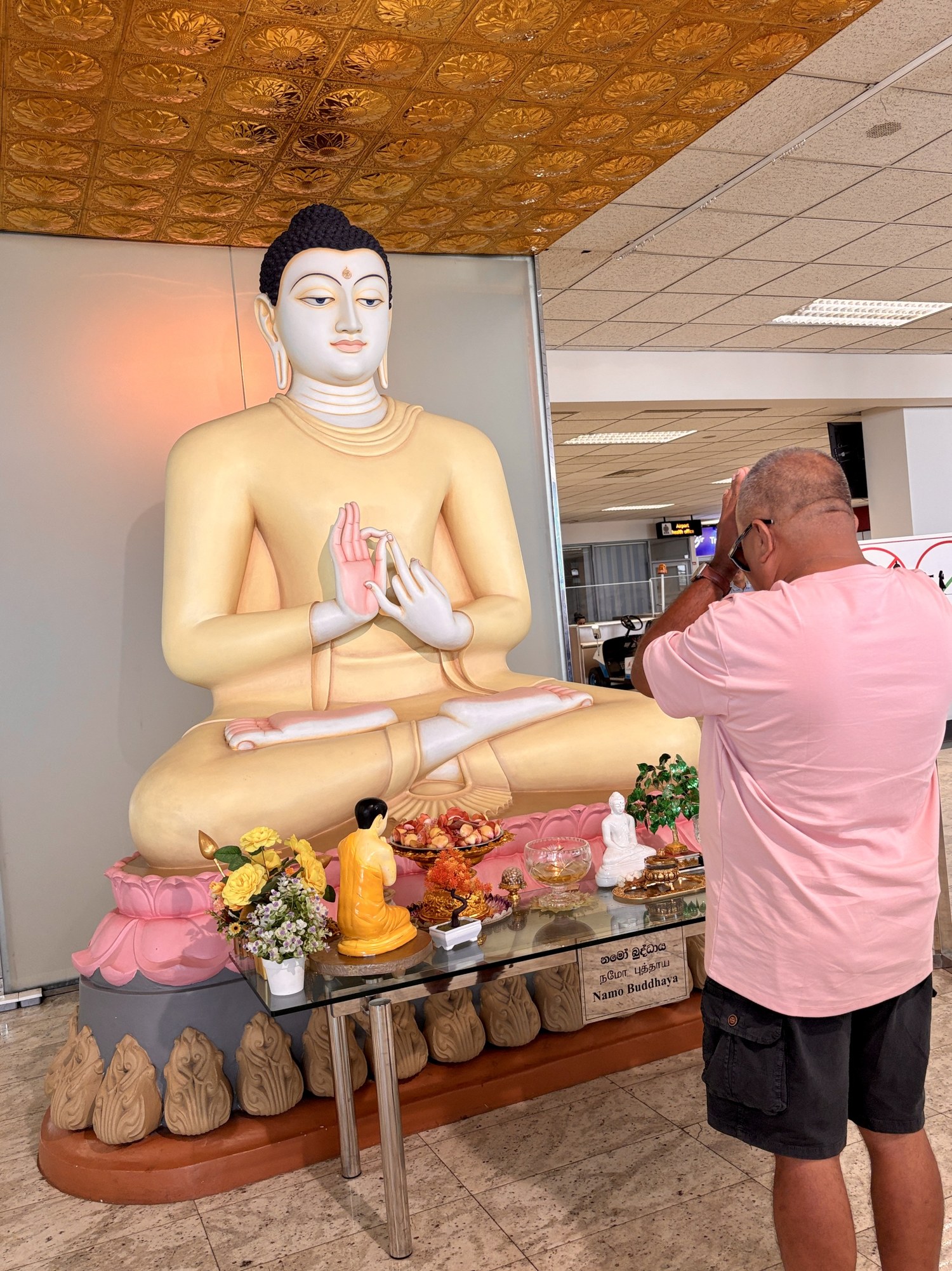
You saw the prayer gesture and stopped — most travellers at Bandaranaike walk past this Buddha installation without noticing the human moments that happen in front of it, but you recognised that the act of reverence was worth documenting.
What is working
Where it stops short
The same five, every time, on the same scale every evaluation uses.
2.6 separates your strongest dimension from your weakest. That gap is where the next evaluation is won.
Where this reading sits against every photograph the engine has read.
This places you in the top 42% of People images evaluated on Shutter League. Your how well you captured the right moment score of 4.5 is below the People average of 6.2 — the gap is in waiting for the gesture to complete rather than capturing it mid-action, and the drill that closes it is simple: next time, do not press the shutter until the hands meet or the head bows.
“You stopped for a moment most travellers walk past.”
Composition · Rule of thirds
Why this score. Being present at Bandaranaike International Airport and photographing a public religious installation requires no special access or environmental difficulty — the statue is placed for travellers to photograph, and the act of prayer is a common occurrence in this space.
Why this score. The straight-on documentation of a man praying before a Buddha statue is the most common framing of this subject — the angle, the inclusion of the full statue, and the airport context are all familiar treatments of public religious moments.
Why this score. The hands-raised prayer gesture is captured mid-action but the moment is generic — the decisive frame would have been the instant the hands met at the heart or the moment the head bowed, when the gesture completes and the emotion peaks.
Why this score. The image documents a public religious moment in a transit space — the wonder is cultural context only, not access or emotional specificity, and the airport Buddha is a widely photographed subject that thousands of travellers encounter.
Why this score. The image suggests reverence but does not deliver a specific emotion — the viewer sees the act of prayer but does not feel the devotion, the gratitude, or the relief that might be present, and the distance and angle keep the moment observational rather than felt.
Standard edit · balanced
Crop tighter vertically — remove the ornate gold ceiling and the white fluorescent grid entirely, keeping only the Buddha statue and the man from waist up. The ceiling is beautiful but it competes with the prayer moment for the viewer's attention. Removing it resolves the hierarchy and makes the human-divine relationship the only subject.
Darken the background terminal signage and distant fluorescent lights by one stop — the bright patches in the upper right corner pull the eye away from the man and the statue. Darkening them keeps the viewer's focus on the prayer gesture.
Increase contrast slightly on the man's pink shirt and the Buddha's cream-gold tones — both subjects are correctly exposed but they blend slightly into the mid-tones of the terminal environment. A small contrast lift separates them from the background and makes the frame feel more intentional.
Creative edit · artistic
Convert to black and white and crush the shadows to near-black while holding the highlights on the Buddha's white hands and the man's raised palms — the image becomes about light and gesture only, the ornate gold ceiling and the pink shirt disappear, and what remains is the universal language of prayer: two sets of hands, one human and one divine, both raised in the same gesture. The transformation strips away the airport context and makes the moment timeless.
Now open
Shivajinagar Market is 15 minutes from you — the flower sellers set up their stalls at 05:30 and the first customers arrive by 06:00, many of them buying marigolds and jasmine for morning puja. Position yourself near the flower stalls and wait for someone to pause, select their flowers, and hold them in both hands before walking away — that two-handed hold is a gesture of reverence and it happens a dozen times every morning. The light at 06:30 is soft and the market is not yet crowded.
You have been shooting within your comfort zone recently. The Depth of Difficulty readings suggest familiar subjects in familiar light. The next level of your work probably requires deliberately harder conditions.
Across your last 10 photographs, over the past 64 days.
This evaluation is currently based on 3092 calibrated images.