 Shutter LeagueShutter League
Higher than 39% of images in the League
1.2 to go to recognition level (8.5) · best this year 9.08
musician tuning before a performance, a parent preparing a child's school uniform the night before. The subject does not know you are there. You are documenting the private ritual that makes the public moment possible.
Shoot it in available light. No flash. Respect the boundary — stay far enough that you are not intruding, close enough that the action is legible. One frame. The hands at work. The face can be turned away.
The discipline here is this: the preparation is as sacred as the performance, and most photographers walk past it to get to the event. You stop for it.
The League of Photographers features genuinely international work — images that stand a chance for recognition, earn income through commissioned work, sales and print editions, and be featured in exhibitions, grants and awards.
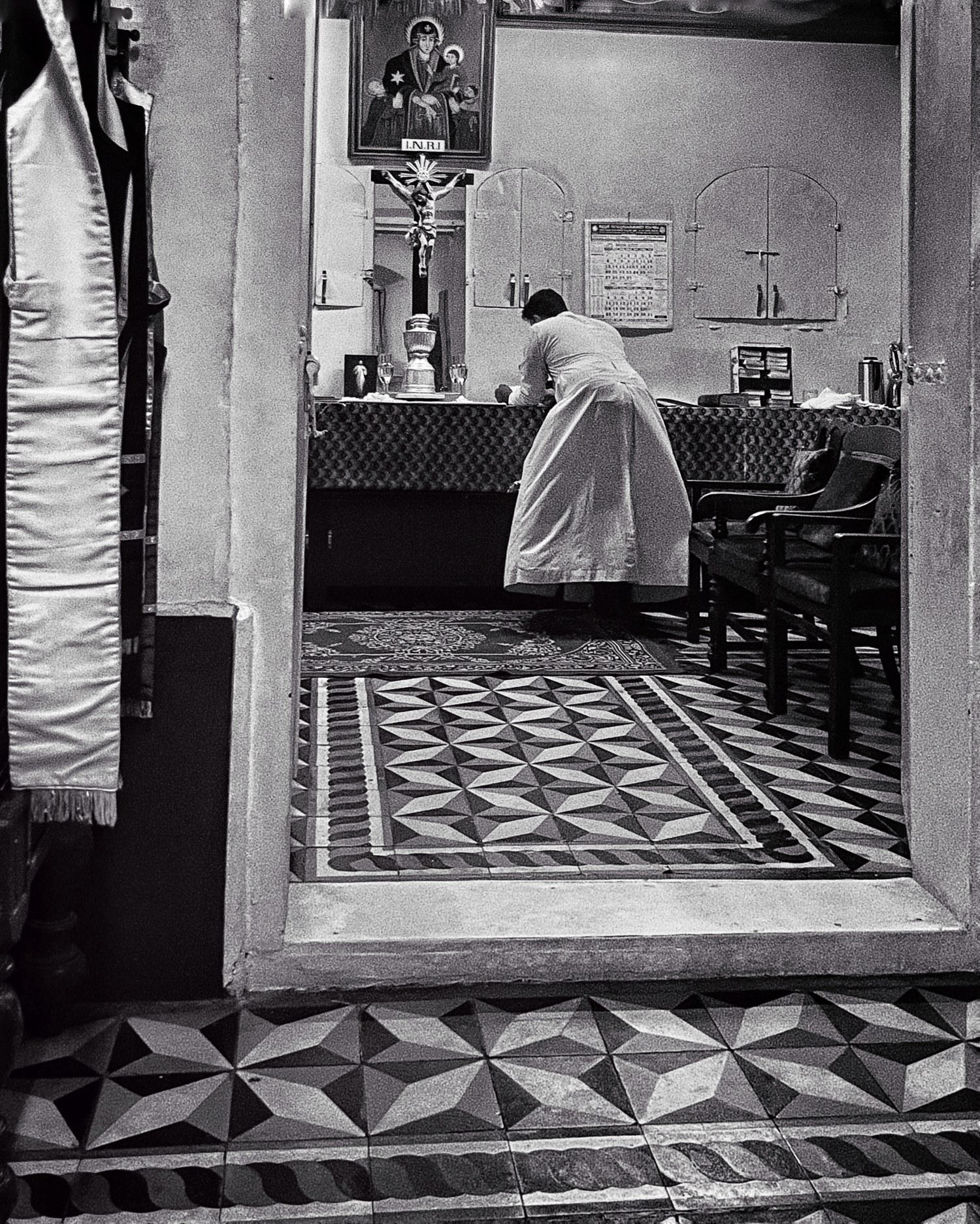
You shot from outside the threshold — the doorway is the frame, and the frame respects the boundary of the sacred space while documenting what happens inside it. That decision is what separates documentary work from intrusion.
What is working
Where it stops short
The same five, every time, on the same scale every evaluation uses.
1.3 separates your strongest dimension from your weakest. That gap is where the next evaluation is won.
Where this reading sits against every photograph the engine has read.
This places you in the top 32% of People images evaluated on Shutter League. Your evaluation of how well you captured the right moment — 6.5 — sits slightly below the Documentary average of 6.8. The hands are mid-gesture rather than at the peak of the preparation, and waiting for that resolution is the one thing that moves this dimension into the next band.
“The reverence here is immediate — a stranger would feel it.”
The reading
The white vestment against the geometric floor, the bowed posture, the crucifix and icon above — you saw the reverence before you saw the photograph.
Your emotion evaluation runs at 7.6 across 25 images — feeling is your established strength, and it is doing the work here too.
The technical read
Shot on a mobile phone in available light — the exposure is balanced across the bright wall and the darker foreground, which tells me you either tapped to expose for the midtones or the phone's computational HDR held both ends of the range. The white vestment is clean without clipping, and the geometric tile floor in the foreground is legible without being oversharpened, which is the sign of restrained processing.
The frame-within-frame structure — the doorway as the compositional border — is a classical documentary choice and it works here because it makes the threshold visible: you are outside, the subject is inside, and that distance is the respect the moment required.
The one technical limitation: the bright patch on the left wall is competing with the white vestment for the eye's attention, and darkening that area in post would make the subject the clear focus.
Composition · Frame within a frame
The eye enters through the geometric floor pattern, rises along the doorframe's vertical edge to the white vestment, and settles on the bowed figure — the curtain fragment on the left pulls attention without anchoring it.
Imagine if you had waited until the priest's hands came to rest on the altar rail — fingers spread, weight settling, the preparation finished but the body not yet turning toward the ceremony. The white vestment catches the same light, but now the gesture is complete and the stillness itself becomes the subject.
The vantage from outside the doorway — a position that respects the sacred boundary while documenting the private preparation — is the access decision that required judgement, and it is visible in the frame as the threshold that separates you from the subject.
Why this score. The vantage from outside the doorway looking in — a position that respects the boundary of the sacred space while documenting the private preparation — is the access decision that most photographers would not make, either entering too far or staying too distant.
The frame-within-frame structure and the geometric tile floor are classical documentary composition — the treatment follows convention rather than breaking it, and the eye settles comfortably rather than being arrested.
Why this score. The geometric tile floor creates a strong visual anchor and the frame-within-frame structure is classical, but the treatment itself follows documentary convention — the subject at work, the environment as context, the moment of preparation rather than ceremony.
The hands are mid-action and the posture is transitional — the peak of this preparation was the instant the gesture completed and the body held still, and that window was a half-second away.
Why this score. The moment of private preparation before the ritual is genuine, but the posture is mid-action rather than at a peak — the hands are moving, the body is transitional, and a half-second later the gesture would have resolved into a clearer statement.
Cultural Wonder — the private preparation before a Catholic ritual in Kerala is a world most viewers outside this community will never witness, and the intimacy of the moment before the ceremony is what creates the pull.
Why this score. Cultural Wonder — the image documents a Catholic ritual tradition in Kerala that most viewers outside this community will never witness, and the private moment of preparation carries more intimacy than the public ceremony would.
Reverence — the bowed posture, the white vestment, the crucifix above, the patterned floor beneath — the image creates a specific feeling of devotion and the weight of tradition, and a stranger would name it in one word.
Why this score. Reverence — the bowed posture, the white vestment, the crucifix and icon above, the patterned floor beneath — the image creates a specific feeling of devotion and the weight of ritual, and a stranger would name it in one word.
You keep choosing the threshold — not too close, not too far — and that restraint is visible across your work. The pattern here is respect: you document devotion without intruding on it, and that boundary is what makes the intimacy possible rather than invasive.
An image at this level belongs in the League of Photographers — where it earns a world standing calibrated against every photographer on the platform.
The standard we are measuring against was built from hundreds of blind calibrations — not preference, not taste — what makes an image hold attention, create feeling, and outlast the five seconds it gets on a feed.
Standard edit · balanced
Darken the bright patch on the left wall — it competes with the white vestment for the eye's attention, and removing that competition makes the subject the clear focus.
Lift the shadows slightly in the foreground tile pattern — the geometric detail is part of the visual strength here, and bringing it up half a stop makes the layering from foreground to subject more legible.
Crop tighter from the left edge to remove the partial curtain — it adds no information and the frame becomes cleaner without it.
Creative edit · artistic
Convert to a warmer black-and-white treatment with lifted midtones and gentle grain — the reverence becomes timeless rather than contemporary, and the geometric floor pattern reads as pure form rather than decorative detail.
Frame 1: The next image in this series shows the same ritual tradition at the moment of public ceremony — the priest facing the congregation, the hands raised in blessing, the private preparation now transformed into the public act. That contrast between preparation and performance is what a body of work on ritual needs.
Frame 2: The second frame shows a different faith tradition in the same city — a Hindu priest preparing oil lamps before evening aarti, a Muslim muezzin climbing the minaret stairs before the call to prayer — the private devotion before the public ritual is universal across faiths, and documenting that universality is the project.
Frame 3: The third frame shows the objects of ritual without the person — the chalice and crucifix on the altar after the ceremony has ended, the empty vestment hanging on the wall, the geometric floor with no one standing on it. The absence completes the presence.
Frame 4: The fourth frame shows the hands of the ritual — not the face, not the full body, just the hands at work on the preparation. The fingers folding the cloth, the palm lifting the chalice, the gesture that carries the tradition forward. That intimacy is what makes the ritual human rather than institutional.
Now open
The Vadakkunnathan Temple complex in Thrissur is close by. The outer corridors and the preparation areas before the evening aarti — not the sanctum, but the threshold spaces where devotees prepare oil lamps, arrange flowers, and perform small private rituals before entering. Early evening, 17:30 to 18:00, when the light is soft and the activity is building. The frame worth making: hands at work on a small ritual task, the face turned away, the preparation visible but the person private.
Decisive Moment has been your most persistent challenge. The moment you are capturing is close to the peak — but consistently arriving a fraction early or late. Start staying with subjects longer than feels comfortable. The frame you want comes after the obvious one.
Across your last 26 photographs, over the past 4 months.
This evaluation is currently based on 3093 calibrated images.