 Shutter LeagueShutter League
Higher than 39% of images in the League
1.2 to go to recognition level (8.5) · best this year 9.08
Position yourself at the threshold, not inside. Wait for the moment when their hands are doing something specific — not ambient preparation, but the one gesture that defines the ritual. That is the frame this moment was reaching toward.
The discipline to wait at the boundary rather than cross it is what makes documentary work honest.
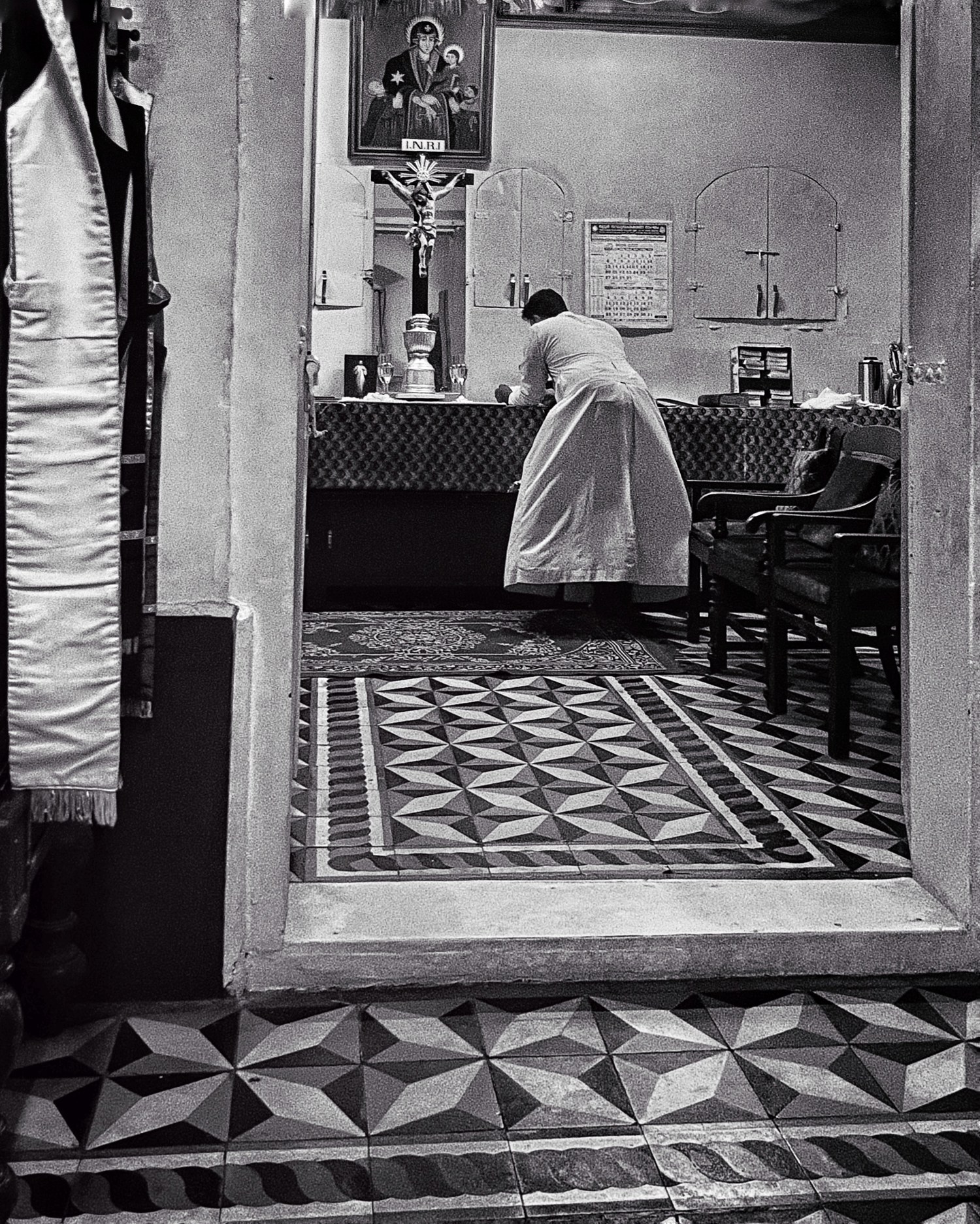
You positioned yourself at the threshold — outside the sacristy, not inside it — and that decision is what makes this image documentary rather than intrusive. Most photographers would have walked into the room for a closer frame. You understood that the boundary itself is part of the story: the private ritual of preparation that happens before the congregation arrives, witnessed but not interrupted.
What is working
Where it stops short
The same five, every time, on the same scale every evaluation uses.
1.3 separates your strongest dimension from your weakest. That gap is where the next evaluation is won.
Where this reading sits against every photograph the engine has read.
This places you in the top 32% of Documentary images evaluated on Shutter League. Your evaluation uses Mobile League weights — Decisive Moment and Visual Disruption are weighted more heavily than in Camera League, recognising that these qualities are harder to achieve on a phone. The effort to get this frame is part of what this evaluation is measuring. Your timing evaluation of 6.5 is slightly below the Documentary average of 6.9 — the frame you caught is the ambient preparation rather than the peak gesture, and that half-beat is what holds this from the next band.
“The reverence here is immediate — a stranger would feel the stillness of this moment without needing to know the tradition.”
The reading
The priest's back is to you, bent over the altar in preparation — you saw the private moment before the public service and you respected the boundary by staying outside the room.
Your Documentary work evaluates at 7.24 on average across 25 images, and your emotion evaluation has been consistently strong — 7.6 here, above the genre average of 6.8. You create images that make strangers feel something specific, and that consistency is what working documentary photographers build their careers on.
The technical read
Shot on a mobile phone in available light — no flash, no artificial lighting — which preserves the authenticity of the moment and avoids disturbing the subject. The exposure is well-balanced: the white vestment holds detail without clipping, the shadows in the foreground retain texture, and the background iconography remains legible. The geometric floor pattern is sharp across the frame, which matters because that detail anchors the composition. The depth of field keeps both the foreground tiles and the priest in acceptable focus, a benefit of the mobile sensor's smaller format. The light is soft and directional, likely from a window outside the frame to the left, creating gentle modeling on the priest's form without harsh shadows. The one technical weakness is the competing luminance on the left wall — a brighter patch that draws the eye away from the intended subject and should be addressed in post-processing.
Composition · Frame within a frame
The eye enters at the doorframe's vertical edge, travels down the geometric floor pattern toward the priest in white vestments, and rests on the bowed figure as the single human element in the architectural space.
Imagine if the priest's hands were lifting the chalice at the exact moment the morning light from the doorway caught the metal — the gesture readable, the light creating a single bright point in the frame, the transition from private preparation to public ritual visible in that one instant. The same reverence, the same boundary respected, but the peak of the act rather than the ambient preparation.
The doorway vantage required positioning yourself at the threshold of the sacred space — outside the room, respecting the boundary while documenting the private ritual — and that restraint is what makes this documentary work rather than intrusion.
Why this score. The vantage point — shooting through a doorway into a sacristy — required positioning yourself outside the room while the priest prepared, respecting the boundary of the sacred space while documenting the private ritual of preparation.
The frame-within-frame composition through the doorway and the geometric floor pattern create strong visual structure, but the treatment itself is familiar in church documentary photography — the eye finds one object (the priest in white) but the compositional approach is not breaking convention.
Why this score. The geometric floor pattern creates a strong visual anchor, and the frame-within-frame composition through the doorway is a deliberate structural choice — but the treatment itself is familiar in documentary church photography.
The priest is in the ambient state of preparation — bending over the altar, arranging items — but the peak instant would have been the specific gesture: lifting the chalice, the hands coming together, the turn toward the congregation.
Why this score. The priest is bent over the altar in preparation — a genuine moment of private devotion before the public service — but this is the ambient state of preparation, not the peak instant of a specific gesture or expression.
Cultural Wonder — the image documents a private moment in the life of a South Indian Catholic community that most congregants never witness: the preparation ritual before the service, the specific visual language of Kerala church interiors with patterned floors and iconography.
Why this score. Cultural Wonder — the image documents a private moment in the life of a South Indian Catholic community, showing the preparation ritual that most congregants never witness, and the specific visual language of Kerala church interiors.
Reverence — the bowed posture, the stillness, the light on white vestments in a quiet room creates a specific feeling of devotion and solitude that a stranger would recognise without needing the caption.
Why this score. Reverence — the bowed posture, the stillness, the light falling on white vestments in a quiet room creates a specific feeling of devotion and solitude that a stranger would recognise immediately.
This photograph tells us you keep finding frames where the subject is unaware and the feeling is legible — that pattern across 25 images is what separates intentional documentary work from accidental capture. You are building a body of work that understands how light, posture, and cultural context combine to create emotional clarity. The standard we are measuring against was built from hundreds of blind calibrations — not preference, not taste — what makes an image hold attention, create feeling, and outlast the five seconds it gets on a feed.
Standard edit · balanced
Darken the bright patch on the left wall — it competes with the priest for attention, and removing that competition makes the white vestment the only light anchor in the frame.
Lift the shadows slightly in the foreground floor pattern — the geometric detail is part of the visual story and right now it is falling into darkness.
Crop tighter from the left edge to remove the partial curtain — it adds no information and the frame becomes cleaner without it.
Creative edit · artistic
Convert to a high-contrast black and white with the floor pattern pushed to near-white and the background walls to near-black — the priest becomes a silhouette in a geometric field, and the image shifts from documentary realism to a study in devotion as form.
Frame 1: The next image in this series shows the same priest at the moment of transformation — lifting the chalice, turning toward the congregation, the private devotion becoming the public act. That transition is what completes the narrative.
Frame 2: The second frame shows the congregation arriving — the first person entering the church, the shift from empty space to community gathering, the contrast between the private preparation you have already documented and the public ritual about to begin.
Frame 3: The third frame shows the hands — a close study of the priest's hands arranging the altar items, lighting a candle, holding the prayer book. The hands are where the ritual lives, and that detail completes the story of preparation.
Frame 4: The fourth frame shows the same space empty after the service — the altar cleared, the chairs empty, the light different. The cycle of ritual: preparation, service, return to stillness. That arc is what a body of work on this subject needs.
Now open
The Vadakkunnathan Temple complex in Thrissur is close by. The annual Thrissur Pooram preparations happen in April-May, but the daily rituals — priests preparing oil lamps at dawn, the cleaning of the inner sanctum before the first puja — happen year-round. Early morning, 05:30 to 06:30, before the public arrives. The frame worth making: hands lighting the first lamp, the smoke rising in the pre-dawn darkness, the private devotion before the temple opens.
Across your last 25 photographs, over the past 4 months.
This evaluation is currently based on 3092 calibrated images.