 Shutter LeagueShutter League
Higher than 2% of images in the League
3.4 to go to recognition level (8.5) · best this year 9.08
Look for one bright subject against a field of darker tones. Shoot it at 45 degrees, as close as your camera will focus. Make the background disappear.
The photographer who notices more makes better images. That is the whole secret.
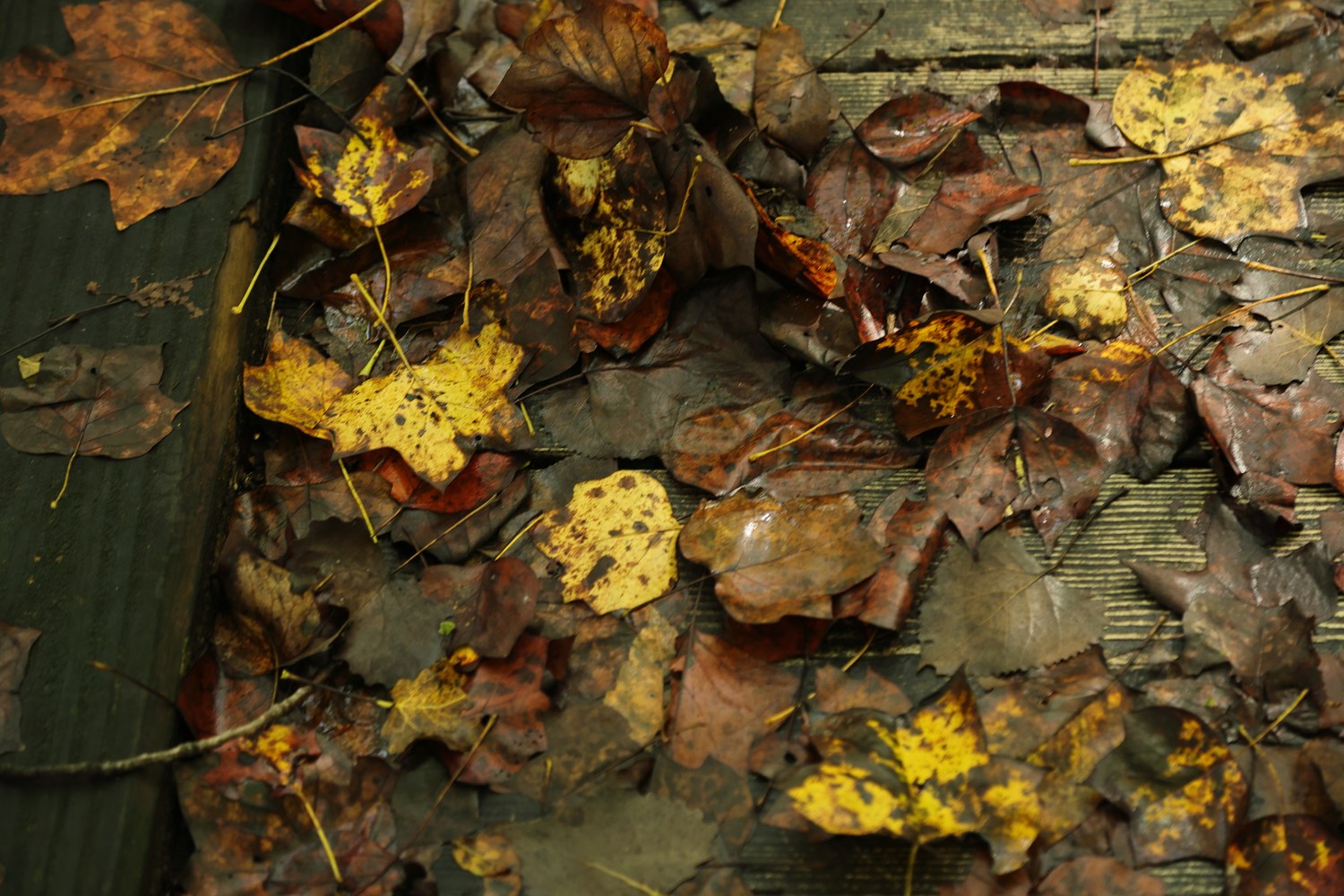
Beautifully seen — you stopped for the quiet moment after the rain, when the leaves are still wet and the colours are saturated and rich.
What is working
Where it stops short
The same five, every time, on the same scale every evaluation uses.
2.4 separates your strongest dimension from your weakest. That gap is where the next evaluation is won.
Where this reading sits against every photograph the engine has read.
This places you in the top 52% of Nature images evaluated on Shutter League. Your how striking the image is to a stranger score of 3.8 is below the Nature average of 5.2 — the overhead flat-lay treatment is familiar, and the multiple competing bright leaves prevent the image from landing with a single clear visual statement. Work on subtraction — one subject, clearly isolated, against a simplified background.
“Lovely instinct — you stopped for the quiet beauty of decay.”
Why this score. Fallen leaves on a wet deck — accessible subject, no environmental hostility, no timing constraint, no physical challenge. The difficulty is in the seeing, not the capture.
Why this score. The overhead flat-lay treatment of autumn leaves is a familiar nature photography approach — the wet surface adds texture but the overall framing follows convention.
Why this score. The moment is the aftermath of rain on fallen leaves — a static scene with no peak to capture, no variables converging, no decision window that opened and closed.
Why this score. The image shows seasonal change and decay patterns that are visible to anyone walking through autumn — no rare access, no hidden perspective, no scientific revelation.
Why this score. The feeling is quiet melancholy — the end of the season, the beauty in decay — but the emotion is suggested rather than fully delivered, and the competing visual elements (bright yellows against dark browns, wet wood grain) dilute the focus.
Standard edit · balanced
Darken the bright yellow leaves in the upper left corner by one stop — they are pulling the eye away from the centre of the frame, and removing that competition lets the viewer settle into the image instead of scanning across it.
Increase contrast slightly to separate the wet leaves from the dry wood — the tonal range is compressed right now, and a small contrast boost will make the leaves feel like they are sitting on the surface rather than blending into it.
Crop tighter to remove the wood plank edge in the upper right — it is a geometric distraction that adds nothing to the story, and removing it simplifies the frame.
Creative edit · artistic
Convert to black and white and push the contrast hard — the yellows become bright whites, the browns become deep blacks, and the image becomes about light and shadow on texture rather than autumn colour. It changes the feeling from seasonal melancholy to something more graphic and abstract.
Now open
Viyyur Kole Wetlands is 8km from you — a 20-minute drive. Right now in late December, the paddy fields are harvested and the wetlands are filling with winter migrants. Go at dawn, 06:15-07:00, when the mist is still low over the water and the light is soft and golden. The frame worth making: a single egret or painted stork in the left third of the frame, the mist behind it falling into soft blur, the water still and reflective. That is the frame that separates.
Coming up
Athirappilly Falls is 55km northeast — a 90-minute drive. January is peak flow season after the northeast monsoon. Go mid-morning, 09:00-10:00, when the sun is high enough to light the spray but not so high that the contrast is harsh. The frame worth making: the base of the falls with a slow shutter speed (1/4s or slower) to turn the water into mist, a dark rock in the foreground sharp and anchoring the composition.
Across your last 25 photographs, over the past 4 months.
This evaluation is currently based on 3092 calibrated images.