 Shutter LeagueShutter League
Higher than 16% of images in the League
2.08 to go to recognition level (8.5) · best this year 9.08
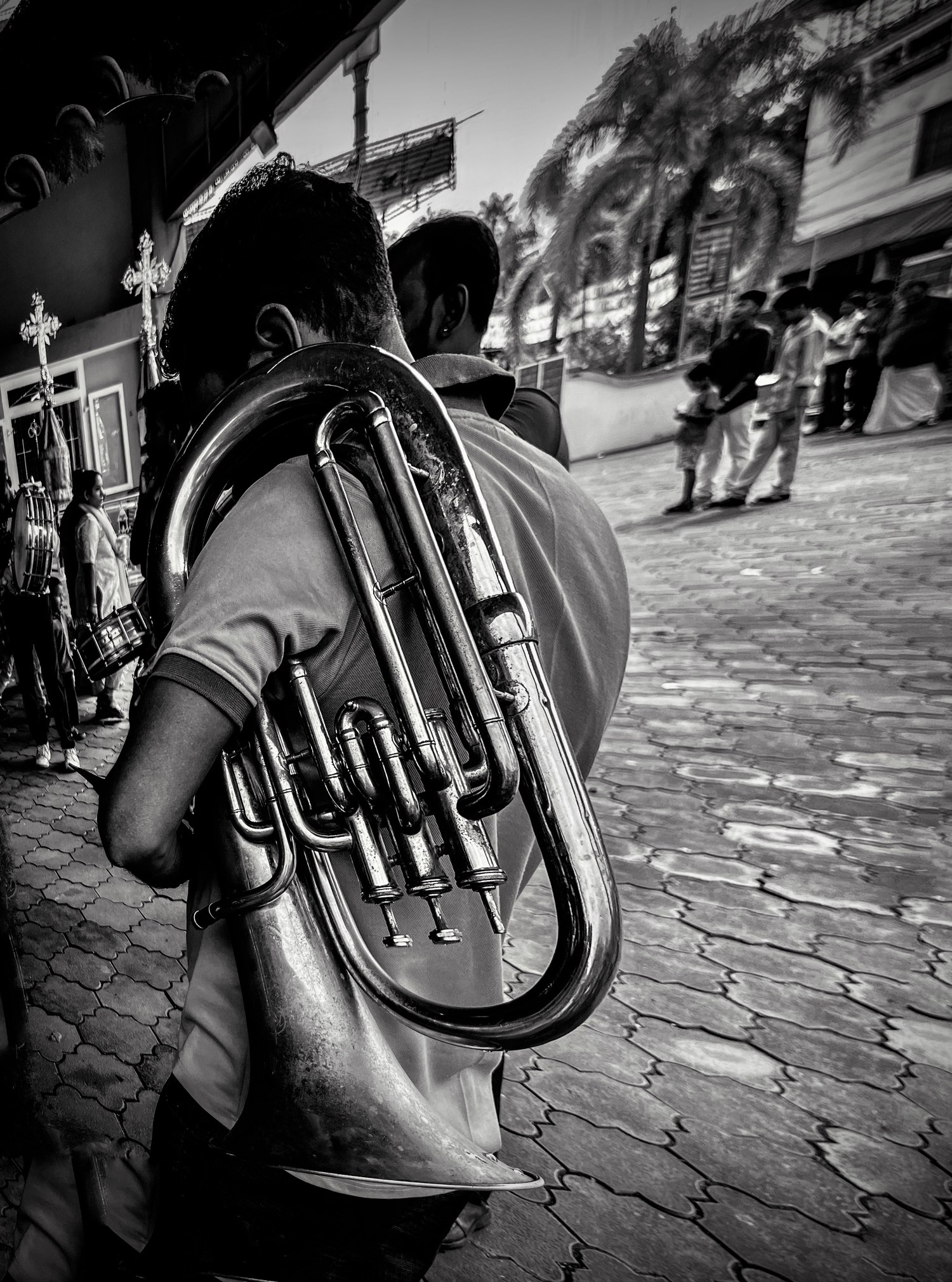
ot on the sidewalk), identify one musician or one ritual object, and pan with them at 1/30s as they move. The instrument or object stays sharp. The world blurs. That is the frame that defines the event.
The photograph you almost made is always better than the one you settled for. You were one shutter speed decision away from that frame here.
Beautifully committed — you chose motion blur as the visual language for this procession and you applied it consistently across the entire frame. Most photographers at this event would have shot at 1/500s and frozen everything. You made a creative decision.
What is working
Where it stops short
The same five, every time, on the same scale every evaluation uses.
1.4 separates your strongest dimension from your weakest. That gap is where the next evaluation is won.
Where this reading sits against every photograph the engine has read.
This places you in the top 38% of Documentary images evaluated on Shutter League. Your how difficult the shot was to capture score of 6.2 is slightly below the Documentary average of 6.8 — the access and positioning were strong, but the technical execution (no sharp anchor in the motion blur) reduced the difficulty score from what the access alone would have earned. Work on panning technique at slow shutters to freeze your primary subject while letting the background streak.
“The edit worked — the background is quieter and the tuba reads faster as the anchor.”
Composition · Leading lines
Why this score. Positioning yourself inside a moving religious procession with a large brass instrument filling the foreground while maintaining compositional control requires physical presence and timing — but the technical execution (motion blur across the entire frame, no sharp anchor) reduces the difficulty score from what the access alone would earn.
Why this score. The over-the-shoulder instrument perspective is less common than the frontal procession frame, and the motion blur treatment adds painterly energy — but the overall visual language (B&W religious procession, motion as atmosphere) is familiar in documentary work.
Why this score. The moment captures the procession in transit with the tuba as the geometric anchor — but the decisive frame would have been the instant when the musician's posture, the instrument angle, and the background figures aligned into a single readable composition, and that window was not fully captured here.
Why this score. Access Wonder is present — you were inside the procession with the band, not observing from the street, and that proximity creates a viewer experience most photographers would not achieve — but the cultural specificity (which tradition, which community, why this procession matters) is not fully communicated by the frame alone.
Why this score. The image creates a feeling of being swept along in something larger than yourself — the motion, the brass weight on the shoulder, the collective movement forward — and that kinetic energy is specific and felt, scoring this in the 7.0+ range where emotion is present and nameable.
Standard edit · balanced
Crop tighter from the right edge — remove the partial white-clad figure at the right mid-ground. The frame is about the tuba and the musician carrying it, not the crowd. Every additional figure dilutes that focus.
Add a subtle vignette to the lower right and upper left corners — this draws the eye inward toward the tuba and reduces the visual weight of the cobblestones and sky.
Increase contrast slightly on the tuba itself — the brass is reading as mid-grey rather than metallic. A targeted curves adjustment on the instrument would separate it further from the background.
Creative edit · artistic
Convert to a high-grain B&W film simulation (Tri-X 3200 pushed) — the motion blur would read as kinetic chaos, the tuba as a sculptural form emerging from noise, and the entire frame would shift from documentary realism to expressionist energy. The feeling would change from 'I was there' to 'this is what it felt like to be swept along in something larger than yourself.'
Now open
PhotoMuse Festival of Photography 2026 is happening right in Thrissur — zero travel needed. National and international photography exhibitions, workshops, and seminars across multiple genres including documentary and people photography. This is a dedicated platform to study how other photographers approach cultural documentation, connect with working professionals, and see award-winning work in person. Contact PhotoMuse museum in Kodaly for specific 2026 festival dates and venue details. Based on your location (Thrissur) · Genre (Documentary) · Your growth opportunity (motion blur technique with sharp anchor).
Across your last 25 photographs, over the past 4 months.
This evaluation is currently based on 3092 calibrated images.