Higher than 98% of images in the League. Grandmaster — Fewer than 1 in 100 reach 9.
99.1410
✓ Five dimensions, one standard
✓ Expert review by Grandmaster mentor
✓ Final evaluation calibrated
Evaluated 28 Jul 2026 · Public
The five dimensions
Aesthetic Quotient (AQ)
9.3↑
Your Strongest
Wonder Factor
9.2
Strong
Visual Disruption
8.9
Strong
Depth of Difficulty
8.7
Strong
Decisive Moment
8.4↓
Your Next Leap
Tap a dimension to see the engine's reasoning · All evaluations out of 10
SL evaluation distribution
059.1410
What Shutter League saw
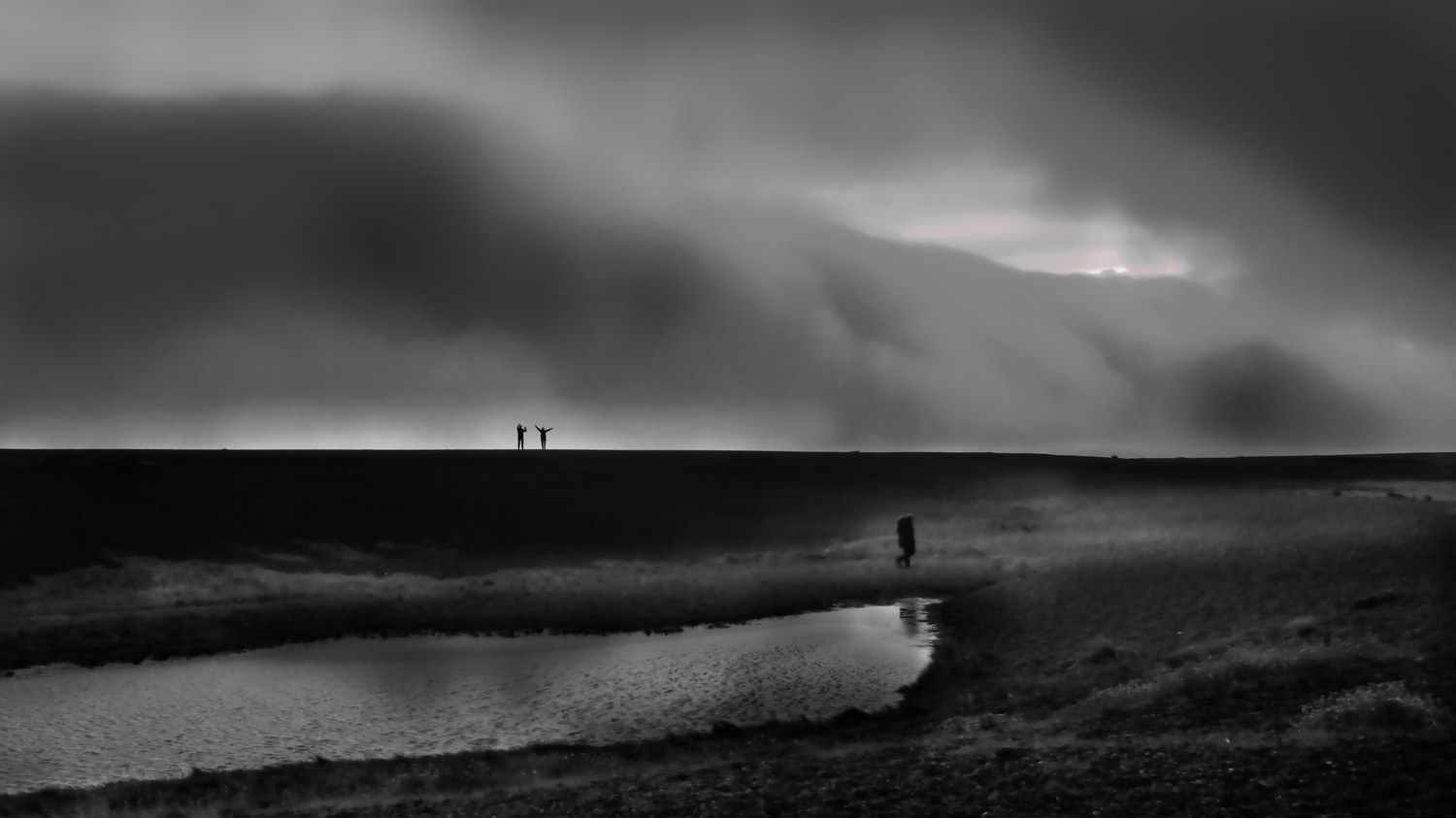
▪ A Grandmaster score means you made an image that most photographers never reach — not because of access or gear, but because you committed to a reduction decision that required genuine vision and technical precision simultaneously.
▪ To reach 9.5+, two things would need to align: the tonal execution you already achieved here, and a single subject instead of three — the raised gesture against the storm with no competing elements, just the void and the defiance.
▪ **Michael Kenna** — his minimalist work in Hokkaido and the English countryside is built on this same discipline: the patience to wait for the exact geometric moment and the courage to strip everything away except the essential truth. Search: Michael Kenna minimalist landscape.
SL Evaluation · Expert-calibrated
A Grandmaster score means you made an image that most photographers never reach — not because of access or gear, but because you committed to a reduction decision that required genuine vision and technical precision simultaneously.
To reach 9.5+, two things would need to align: the tonal execution you already achieved here, and a single subject instead of three — the raised gesture against the storm with no competing elements, just the void and the defiance.
Michael Kenna — his minimalist work in Hokkaido and the English countryside is built on this same discipline: the patience to wait for the exact geometric moment and the courage to strip everything away except the essential truth. Search: Michael Kenna minimalist landscape.
Next time you are at any open landscape at dawn or dusk with storm light building: position yourself so a single human figure or lone tree is silhouetted against the brightest part of the sky — expose for the sky, let the subject go pure black, and wait for the exact moment when the geometry resolves.
YOUR NEXT BODY OF WORK SEQUENCE: The story is solitude under vast sky. Frame 1: a lone figure with arms raised at the exact moment of storm break — defiance or surrender, the viewer cannot tell. Frame 2: the same landscape empty — no human presence, just the water channel and the storm receding. Frame 3: a close frame of wet grass or a single footprint in mud — the trace of presence after the person has gone, and that is the frame that stays with you.
The photograph you almost made is always better than the one you settled for.
A note on your Street eye in a Creative frame: Your Street training gave you the instinct to wait for the raised gesture — that decisive human moment — and it is why the composition works. The Creative gap you closed here: committing to the reduction and letting the subject become geometry instead of story.
Boldly committed — you saw human figures and chose to treat them as geometric punctuation instead of human subjects, and that reduction decision is what separates this from the thousands of storm landscape frames made every day.
Michael Kenna — his minimalist work in Hokkaido and the English countryside is built on this same discipline: the patience to wait for the exact geometric moment and the courage to strip everything away except the essential truth. Michael Kenna minimalist landscape.
This image has a story because it shows what most photographers would walk past — the raised gesture under a storm is everywhere, but the decision to reduce it to pure geometry and negative space is rare.
What stood out
Exceptionally patient — you waited for the exact instant when the storm break, the raised gesture, and the water reflection aligned into a frame that most photographers would never commit to because they would be chasing the obvious subject instead of the reduction.
▪ Next time you are at any open landscape at dawn or dusk with storm light building: position yourself so a single human figure or lone tree is silhouetted against the brightest part of the sky — expose for the sky, let the subject go pure black, and wait for the exact moment when the geometry resolves.
▪ YOUR NEXT BODY OF WORK SEQUENCE: The story is solitude under vast sky. Frame 1: a lone figure with arms raised at the exact moment of storm break — defiance or surrender, the viewer cannot tell. Frame 2: the same landscape empty — no human presence, just the water channel and the storm receding. Frame 3: a close frame of wet grass or a single footprint in mud — the trace of presence after the person has gone, and that is the frame that stays with you.
▪ The photograph you almost made is always better than the one you settled for.
A note on your Street eye in a Creative frame: Your Street training gave you the instinct to wait for the raised gesture — that decisive human moment — and it is why the composition works. The Creative gap you closed here: committing to the reduction and letting the subject become geometry instead of story.
Exceptionally patient — you waited for the exact instant when the storm break, the raised gesture, and the water reflection aligned into a frame that most photographers would never commit to because they would be chasing the obvious subject instead of the reduction.
Set against your weakest dimension
Hesaraghatta Lake
Hesaraghatta Lake is 45 minutes from you — the water level is low right now and the exposed mudflats create vast negative space at dawn. Arrive at 06:15, position yourself so a lone fisherman or wading bird is silhouetted against the brightest part of the sky, and wait for the exact moment when the geometry resolves — the frame worth making is the one where the subject is pure black and the negative space carries all the weight.
Edit suggestions
Balanced · Light editing
Darken the upper left corner by one stop — the bright patch is competing with the light break in the upper right for the eye, and removing that competition makes the storm break the clear focal point.
Increase contrast slightly in the silhouettes — the figures are already pure black but a touch more separation from the midground mist would make the geometry even cleaner.
Crop tighter from the bottom — remove the lower third of the foreground grass and water channel, bringing the horizon line higher in the frame and increasing the weight of the storm sky above the figures.
Artistic · Heavy editing
Convert to a high-key minimalist treatment — push the sky to near-white, hold the silhouettes as pure black, and remove all midtone detail — the image becomes a study in absence and the raised gesture becomes the only anchor in a void.
How this photographer is developingLast 30 photographs
League standing is determined by calibrated evaluation against the Shutter League standard. Standings reflect evaluated photographs only.
Terms & Conditions ·
Privacy Policy ·
Refund Policy